
A verified petition filed in Cook County Circuit Court alleges donor fraud, directives to staff not to mention "guns," representations that "100% of donations" go to Israel, edited Zoom recordings, deleted WhatsApp messages, and the suppression of internal reports. The petition cites eleven federal criminal statutes — including RICO and the Arms Export Control Act. Friends of United Hatzalah has responded by deploying its tax-exempt resources to shield individual executives from personal liability. The case is active.
"The December 17, 2025 correspondence identified, among other things, donor fraud, '[v]olunteer Protection' fundraising materials, directives that staff should not mention 'guns,' representations that '100%' of donations were going to Israel, allegations regarding edited Zoom recordings, deleted WhatsApp messages, and the suppression or concealment of reports and communications. Prior to her termination, our client engaged in numerous instances of protected activity including repeatedly raising issues of donor fraud to the named individuals."
"The use of organizational resources to defend individuals against claims that have been asserted against them personally, and the interposition of FoUH as a litigation shield to prevent discovery into those individuals' conduct, may itself constitute a breach of the fiduciary duties owed by FoUH's officers and directors to the organization and its charitable mission."
"Despite these representations, no legal entity named United Hatzalah International, UH International, or United International has been identified in any jurisdiction through diligent searches of domestic and foreign corporate, nonprofit, and tax records. No separate tax filings, corporate registrations, governing documents, or organizational disclosures identifying such an entity have been located."
A Federal Lawsuit, Donor Fraud Allegations, and Documented Misconduct
Sources: @EliBeerUH, Dec 25 2024 • @RabbiShmuley, May 29 2024
The same claims, told differently, across 12 years of public statements, fundraising pitches, and media appearances. Every item below is sourced from primary documents, court records, or UH's own published materials.
See the full pattern ↓The discrepancies documented in this investigation are not isolated errors. They form a pattern: the same claims told in different ways to different audiences across more than a decade. Each row below tracks a single claim as it shifted across platforms, years, and fundraising contexts.
A WhatsApp group connected to United Hatzalah's Jerusalem volunteer network — described internally as a "Family of Kindness" welfare channel — shows an administrator identified only as N. Y. soliciting donations for seven volunteer families who could not afford holiday groceries. The messages circulated in early 2026, the same period in which the organization's US fundraising arm was processing hundreds of millions of dollars in donor contributions.
N. Y.'s fundraising appeal was not an isolated case. A separate message to UH CEO Prof. Ehud Davidson described a volunteer family with five children, aged one to eleven, in extreme poverty: "The children eat bread for days just to stop the hunger. This month they didn't pay rent or babysitter. The single salary goes immediately to credit debt." The family requested ₩3,500 for groceries and ₩1,500 for childcare to survive the month.
The welfare fund that Eli Beer promoted for situations like these — Chasdei HaMatzilim (registration 580652576) — had an annual budget of ₩1.1 million. That is 0.19% of United Hatzalah's ₩573 million annual revenue.
This investigation examines a 2024 internal embezzlement arrest, a 2021 court judgment for defamation, unverified public claims made during fundraising, and the opaque structure of a global charity network spanning six countries.
Four findings, each sourced directly from primary documents. Screenshot and share.
In this video, Jona Rechnitz — who pleaded guilty in 2016 to federal honest services wire fraud in the Southern District of New York — describes his personal relationship with United Hatzalah founder Eli Beer and takes credit for introducing Floyd Mayweather to the organization.
"I met Eli Beer about 20 years ago and we became very close friends. I had the privilege of introducing Floyd to Eli and the organization." — Jona Rechnitz
Eli Beer speaking at a fundraising event, claiming United Hatzalah volunteers found a baby in an oven. Israeli officials and independent journalists have not been able to verify this account. No retraction has been issued.
Transcript: "Little children. Some of them had grandparents who were Holocaust survivors and they were murdered in a Holocaust in Israel in 2023. Little babies, little children. You couldn't even recognize if they were kids. We saw a little baby in an oven. They put them in, these bastards put these babies in an oven and put on the oven. We found the kid a few hours later."
In the weeks and months following the Hamas-led attacks of October 7, 2023, United Hatzalah founder Eli Beer made a series of graphic public statements about atrocities he claimed to have personally witnessed or verified. These statements were made at fundraising events and public appearances, and were widely repeated in Jewish community media.
At the Republican Jewish Coalition conference in Las Vegas, Beer described an incident involving a pregnant woman whose stomach was allegedly cut open and whose unborn child was stabbed before she and her family were murdered. He also repeated claims that babies had been placed in ovens and burned alive. Beer additionally stated that United Hatzalah volunteers had killed or captured more than one hundred terrorists during the attacks.
Israeli officials and independent journalists subsequently reported that they could not confirm these specific accounts. United Hatzalah has not retracted the claims. The organization raised tens of millions of dollars in the months following the attacks, with the US entity reporting $144.9 million in total revenue for 2023, compared to $48.6 million in 2022.
The pattern raises a question that investigators and journalists have begun to examine: when a charity makes dramatic, emotionally compelling claims during a fundraising surge, and those claims later prove unverifiable or false, what obligation does the organization have to correct the record? United Hatzalah's own history, including the 2021 court finding that it made false statements about MDA, adds context to that question.
It is important to note that the October 7 attacks were real, that United Hatzalah volunteers did respond to the attacks, and that many of the atrocities committed that day have been documented and verified by Israeli authorities and international investigators. The concern raised here is specific: that particular claims made by Beer at fundraising events, and repeated in donor appeals, have not been substantiated and have not been corrected.
Beer's account of a baby baked alive in an oven was amplified by prominent political figures before it could be verified. On October 31, 2023 — while Israeli officials were still unable to confirm the claim — attorney and activist Brooke Goldstein shared a video of Beer's testimony, calling it "absolutely shocking" and describing Beer as testifying to "what he witnessed." Florida politician Randy Fine retweeted it the same day, writing: "I won't lie — I wept openly when I heard this live on Saturday." He added the hashtags #AvengeThem and #BombsAway — a public call for retribution based on an account that has never been independently verified.

Randy Fine (@VoteRandyFine), Oct 31, 2023 — retweeting Brooke Goldstein's amplification of Beer's claim
Note: The Israeli government's own October 7 documentation process, along with reporting by Haaretz, the Washington Post, and other outlets, found no verified evidence of a baby being placed in an oven. Beer has not retracted the claim. No United Hatzalah statement has acknowledged the inability of investigators to confirm it.
United Hatzalah produced an advertorial documentary for i24 News covering its command center operations on October 7, 2023. In one captured exchange, Eli Beer is heard giving a direct instruction to his team: do not let volunteers remain in the active danger zone at Sha'ar HaNegev. In the months that followed, Beer repeatedly fundraised on the narrative that UH volunteers ran toward danger while MDA ran away. The video below is from UH's own production.
The clip takes place inside United Hatzalah's command-and-control center on the morning of October 7. Multiple officers are visible at workstations with live maps. The exchange captured on film centers on a direct tactical disagreement about whether UH responders should remain at Sha'ar HaNegev, near the Gaza border, where Hamas terrorists were active.
Chief Medical Officer Elad Bachar orders teams to evacuate: "I don't want anyone at Sha'ar HaNegev — tell the team of responders to get out of there! They should grab the injured and get out!"
Eli Beer then gives a directive focused on staging safely away from the threat: "Listen, you can't stay there; there are lots of civilians. You can't put them in danger. Let them find a safe place to stage."
Bachar responds: "But we're in a war now!" — indicating that Beer's instruction to hold back was in tension with the urgency of the situation on the ground.
The documentary narrator describes the moment as one where "disagreements emerge amongst the officers" — an acknowledgment, in UH's own production, that the organization's leadership was actively debating whether to send volunteers into the danger zone.
Israel's Ministry of Health has designated Magen David Adom (MDA) as the country's sole national emergency dispatch authority. Under that designation, 101 is Israel's official emergency medical number. In 2010, United Hatzalah was assigned the abbreviated hotline 1221 by ministerial recommendation — a number intended for organizational contact, not for public emergency dispatch.
The distinction matters. In its July 2021 ruling, the Tel Aviv District Court found that United Hatzalah had violated a Ministry of Health directive by continuing to advertise 1221 as an emergency number, rather than directing the public to 101. Justice Naftali Shilo wrote in the 42-page judgment that this conduct was "dangerous and harms public safety," citing the State Comptroller's report. The court found that United Hatzalah had ignored the Ministry's directive and continued publishing 1221 as an emergency contact despite being told to stop.
Magen David Adom's position, which the court did not contradict, is that two competing emergency numbers create confusion — particularly in high-stress situations where seconds count. Israel does not have a unified dispatch system like 911 or 999. Each service operates its own line: police is 100, fire is 102, and MDA is 101. Adding a competing emergency number, MDA argued, risks callers reaching the wrong service or delaying the dispatch of an ambulance.
In July 2023, the Israeli Supreme Court rejected MDA's petition to cancel 1221 entirely, ruling that the number's original assignment was valid. That ruling preserved United Hatzalah's right to operate 1221 as an organizational contact line. It did not address or overturn the Ministry of Health directive against advertising it as an emergency number, nor did it revisit the 2021 District Court finding that doing so was dangerous.
As of June 2026, Eli Beer's verified Instagram profile (@eli_beer, 27,400 followers) lists "Hotline: 1221" in the biography section, alongside the description "Providing free emergency care across Israel" and a "90-seconds response goal." The profile does not reference 101 or indicate that 1221 is not Israel's official emergency number. Beer has made similar references to 1221 as a primary emergency contact in fundraising materials, public speeches, and social media posts, including a January 2025 Instagram reel in which he described 1221 as "a lifeline."
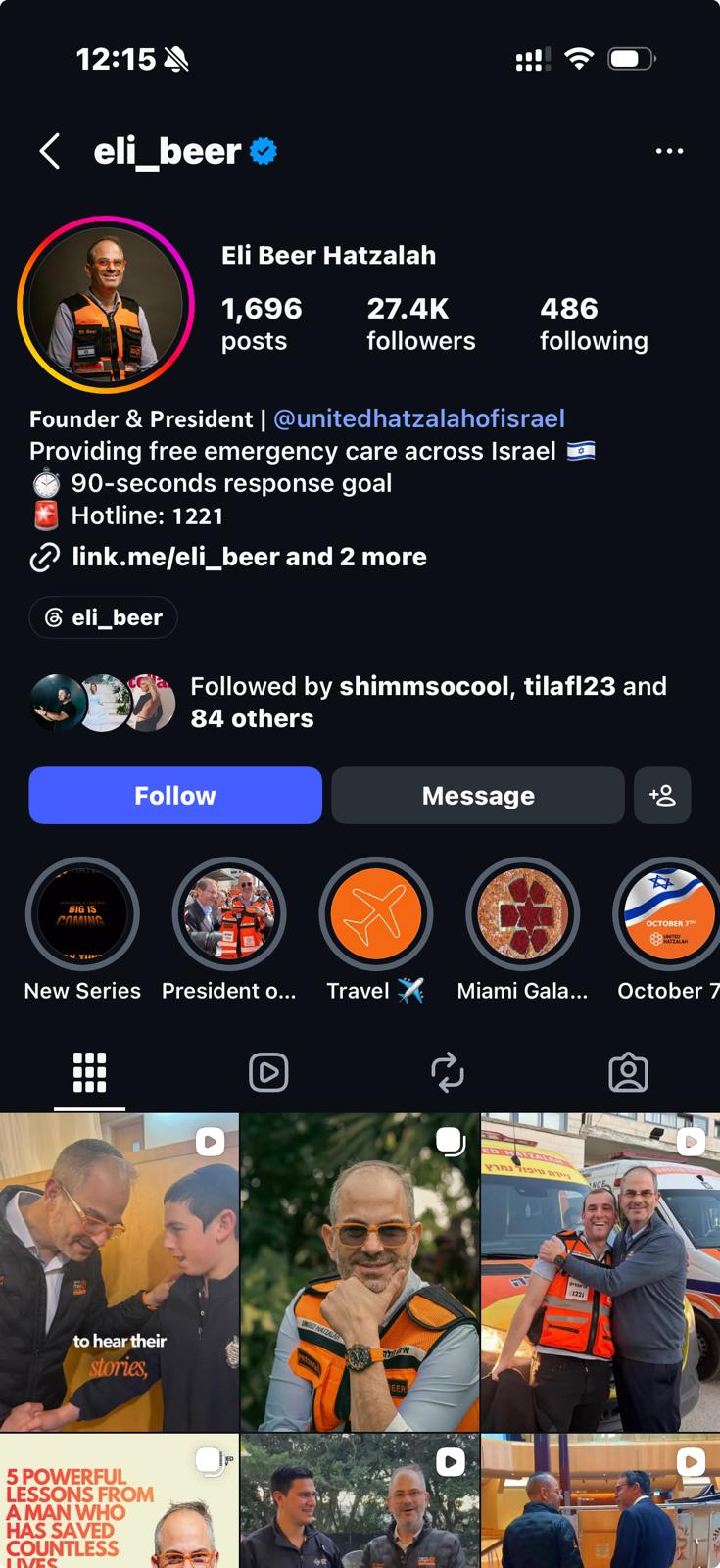
Eli Beer's verified Instagram profile (@eli_beer) as of June 1, 2026, listing "Hotline: 1221" alongside "Providing free emergency care across Israel." The profile does not reference 101, Israel's official emergency number.
On June 7, 2026, The Proctor Effect podcast posted a 90-second Instagram reel featuring Eli Beer. The clip, drawn from a longer episode titled "The Line He Crossed: Saving Lives Beyond Politics," makes five specific factual claims. Each is checked below against primary sources.
[0:00] "When I was six years old, I was in a bomb attack. I remember the screaming, I remember the hysterical situation people were in."
[0:06] "One person destroyed the world, killed so many millions of Jews. I said if he was able to kill six million Jews, maybe I could save six million Jews."
[0:14] "And I remember an emergency we had of a seven-year-old boy who choked, and we were the ambulance called to save this kid's life, and it took us 21 minutes to arrive."
[0:30] "At that moment I had the worst moment of my life. I saw a child die waiting for help."
[0:47] "While the ambulance is on the way fighting traffic, I will have a network of volunteers responding to calls within 90 seconds."
[1:04] "What's more important, getting caught or saving lives? And I said I want to save lives, so that's why I took the risk."
[1:18] "Why was United Hatzalah so prepared for October 7th? Because we're prepared to save a baby choking."
Transcription via AI speech-to-text. Full audio archived.
Eli Beer was born on September 13, 1973. The bus bombing he has consistently cited as his founding motivation is the bombing of Jerusalem Bus #12 on June 2, 1978. On that date, Beer was 4 years, 8 months old — not six.
The age he assigns to this story has shifted across platforms. United Hatzalah's own website (israelrescue.org) and the ArtScroll book description both say "five-year-old Eli Beer." His TEDMED biography and Wikipedia cite "age seven." A Facebook post from the official UH account says "age of six." An Authority Magazine interview says "At age 6." In this reel, he says six again. No version is consistent with the documented date of the bombing and his documented birth year.
| Source | Age Claimed |
|---|---|
| This reel (June 2026) | Six |
| israelrescue.org / ArtScroll book | Five |
| TEDMED biography / Wikipedia | Seven |
| Authority Magazine interview | Six |
| United Hatzalah Facebook (official) | Six |
| Bus #12 bombing date vs. birth date | 4 years, 8 months (actual) |
United Hatzalah's own FAQ page acknowledges the 90-second figure is a goal, not a documented operational standard. The organization's published average response time is under three minutes nationwide. The FAQ states: "UH is focused on reducing response times by increasing the number of volunteers" — framing 90 seconds as an aspiration, not an achievement.
UH's own website describes the 90-second target as applying to "major cities" only, not nationally. The organization's Wikipedia article states the average is "less than 3 minutes nationwide and 90 seconds in metropolitan areas." The reel presents 90 seconds as the universal operational standard without qualification.
This statement refers to UH operating without proper authorization in its early years. In the 2024 UH documentary, Beer states on camera at timestamp 05:11: "We would steal Magen David Adom's calls" — describing how UH purchased police scanners to intercept MDA's emergency dispatch frequency and arrive at scenes before MDA ambulances. The reel frames this as entrepreneurial risk-taking. The court record frames it differently.
The 2021 Tel Aviv District Court (Case 40739-12-18) found that United Hatzalah conducted a "coordinated plan to defame and libel Magen David Adom" and ordered ₪250,000 in damages. The court found the broader pattern of competitive behavior against MDA — including the public narrative that UH was faster because MDA was slower — to be defamatory. The reel presents the same competitive framing as heroism without disclosing the court's findings.
The claim of preparedness sits alongside a figure that is operationally impossible to justify. The UH documentary states at timestamp 23:34: "I can say with certainty, 800 people would not have survived if not for United Hatzalah." A Jerusalem Post op-ed by Liel Pollak (January 15, 2024) citing UH claims states: "Our volunteers saved more than 2,500 lives on October 7."
On October 7, the IDF and Magen David Adom held operational command. They controlled triage, evacuation routes, and hospital transfer. United Hatzalah is a volunteer first-response organization — it has no military clearance, no trauma hospital capacity, and no command authority over the emergency response chain. The determination of whether a life was "saved" belongs to the agencies that controlled that chain: IDF combat medics, MDA paramedics, and trauma surgeons at Soroka, Barzilai, and Shamir hospitals. No case records, no methodology, and no independent verification have ever been published for either figure. The organization has never explained how it calculated either number or what role it played that IDF and MDA did not.
This is the founding story of United Hatzalah, repeated in Beer's TED Talk, his book, and hundreds of interviews over more than a decade. No independent documentation of this specific incident has ever been published — no date, no location, no name, no dispatch log, no hospital record. The story is the emotional foundation of the organization's fundraising narrative and brand identity.
The absence of any verifiable record does not mean the incident did not occur. It means the claim rests entirely on Beer's personal testimony and cannot be independently confirmed or denied.
Over more than a decade of public speaking, fundraising, and media appearances, Eli Beer has made a series of claims that have been directly contradicted by medical evidence, official records, Israeli journalists, and in several cases by United Hatzalah's own published materials. What follows is a documented record of those contradictions.
Beer made this claim before the Republican Jewish Coalition conference, presenting it as something he personally witnessed. The claim spread rapidly, cited by commentators and politicians and viewed tens of millions of times across social media.
No such victim appears on the Israeli government's comprehensive published list of October 7 casualties. The only infant killed that day was 9-month-old Mila Cohen, who was shot while her mother held her. The claim of a woman being "exactly four months pregnant" — a precision that would require medical confirmation — has never been supported by a hospital record, a named victim, or any official Israeli source.
Critically, United Hatzalah's own official book documenting its October 7 response, Angels in Orange, includes a full chapter about Beer's RJC speech — with photographs — but makes no mention of this alleged eyewitness account. The one documented case involving a pregnant woman involved a woman in her third trimester who was brought to Soroka Medical Center with shrapnel wounds; her fetus did not survive. That case has a named treating physician, Prof. Rely Hershkovitz, and a hospital record.
Beer championed the claim that Hamas had burned a baby alive in an oven, attributing it to a United Hatzalah volunteer. He repeated it across multiple platforms and compared those who questioned it to Holocaust deniers, stating: "I believe the testimony I received, not Ha'aretz."
Israeli journalists and police conducted forensic investigations and found no evidence to support the claim. A representative of ZAKA, the first-responder organization that processed the bodies at the kibbutzim, publicly stated the claim was false. The story has been listed by multiple independent fact-checkers as one of the most widely circulated unverified claims of the October 7 aftermath. It was cited in the Wikipedia article on misinformation in the Gaza war as a claim "repeated by journalist Dovid Efune, commentator John Podhoretz and others, in tweets seen over 10 million times" — with Israeli journalists and police finding no evidence for it.
In a September 2025 investigation, journalist Daniel Mael reported that an IDF source confirmed Beer's account of the stomach-cut story was fabricated. The investigation, titled "False Witness," detailed how Beer's most viral October 7 claim could not be corroborated by any military, medical, or forensic source.
In speeches and fundraising appearances, Beer has repeatedly described his 2020 COVID hospitalization at the University of Miami as a near-death experience in which doctors gave him a 5% chance of survival. The story has become a central part of his public narrative and fundraising pitch.
The University of Miami's own published account of his case states he had a "50-50 chance of survival." The UHealth patient story, published by the University of Miami on May 27, 2022, reads: "His COVID symptoms soon worsened to a terrible case of pneumonia that would leave him in a coma for 18 days, with a 50-50 chance of survival."
Beer's origin story, told in his 2013 TED Talk and repeated in hundreds of subsequent appearances, describes how he began his first-response work as a teenager after witnessing a bus bombing. In various tellings, he implies or states he founded the organization as a teenager or very young man.
The chronology does not support this. Beer was born in 1973. United Hatzalah of Israel was formally incorporated in 2006, when he was 33 years old. His own biography on the israelrescue.org website states he "began volunteering on an ambulance at the age of 15" — not that he founded the organization at that age. The founding story has shifted across different tellings: some versions cite a 1978 bus bombing (when he would have been 5), others describe him responding to a 1995 bombing as a teenager.
In speeches following October 7, Beer claimed that Russia planned or orchestrated the Hamas attack as a geopolitical distraction from the war in Ukraine. He presented this as fact rather than speculation.
No U.S., Israeli, or Western intelligence agency has publicly supported this claim. The CIA, NSA, and Israeli intelligence services have stated they found no evidence that Russia had advance knowledge of or planned the October 7 attack. The claim has not appeared in any official government assessment.
In fundraising speeches, Beer has described saving a 70-year-old man's life as a teenager by packing a severe neck wound with his kippah (skullcap) when no other medical supplies were available. The story is a staple of his public appearances and is used to illustrate the need for community first responders.
The claim is medically implausible as described: a kippah is a thin fabric cap with no hemostatic properties, and packing an arterial neck wound with such material in the manner described would not achieve the compression needed to prevent fatal blood loss. The story also conflicts with other versions of Beer's founding narrative, which place his inspiration in witnessing a bus bombing rather than a personal rescue. United Hatzalah's official published materials do not include a corroborated account of this specific incident.
In the "Funding & Finances" section of its official FAQ, United Hatzalah states that in 2023, its revenue included "government and municipal support ($2.6M / ₩9.5M / NIS 9.5M in 2023)." This figure minimizes the organization's reliance on Israeli state funds.
Data from Open Budget Israel (next.obudget.org) shows that United Hatzalah actually received ₪16,502,087 in state funds over a three-year period (₪556,752 in contracts and ₪15,945,335 in support grants), ranking it #3 in income from state funds in its category. The public FAQ figure underreports the full scope of government funding the organization receives.
In a 2024 interview, Eli Beer claimed that because ZAKA was overwhelmed after October 7th, United Hatzalah used their trucks to transport 300 bodies to the Shura military base before ZAKA fully mobilized.
This specific claim regarding the transport of 300 bodies to Shura base by United Hatzalah trucks has not been verified by the IDF, ZAKA, or independent media reports covering the forensic and identification efforts at the Shura base.
This is the founding story of United Hatzalah. Beer has told it at TED, TEDMED, the Republican Jewish Coalition, and at donor events across the United States, United Kingdom, Canada, and Australia for more than fifteen years. It is the emotional core of every fundraising pitch the organization has ever made. It is the reason donors write checks.
In fifteen years of public telling, no date has ever been given. No name. No neighborhood. No hospital. No dispatch log. No treating physician. No family member. No corroborating witness of any kind. The story involves a child who either survived (in which case there is a family, a hospital record, and a name) or did not survive (in which case there is a death record, a family, and a name). Neither has ever been produced.
The age of the boy has also shifted. In the TED Talk it is a seven-year-old. In other tellings it is a child, or a baby, or a young boy. The response time has varied between 20 and 21 minutes depending on the version. The location is sometimes Jerusalem, sometimes unspecified. The one constant is that United Hatzalah was not there — and that Beer decided to change that.
The story is not impossible. It may have happened. But the standard applied to every other claim on this page — that extraordinary claims require verifiable evidence — applies here too. An organization that has raised over $300 million from donors on the basis of this story has never produced a single primary source to support it.
This is the description United Hatzalah submits to JNS as its official publisher blurb. It is also the framing used in donor appeals, TED Talk introductions, and press releases across fifteen years of fundraising. The word “fully volunteer” is load-bearing: it implies that every dollar donated goes to operations, not salaries.
Their own FAQ, published on israelrescue.org, directly contradicts this. Under the heading “UH relies on volunteer medics — so why are paid employee staff members needed?” the FAQ states:
The FAQ also confirms that Eli Beer himself is compensated: “Executive staff includes Eli Beer (who is only compensated by Friends of United Hatzalah).” His compensation is listed on the publicly available IRS Form 990. In 2022, Beer received $567,000 in total compensation from Friends of United Hatzalah Inc.
The organization is not “fully volunteer.” It has a paid call center, paid trainers, paid fleet technicians, paid administrative staff across IT, HR, legal, and maintenance, and a salaried executive team. The responders who arrive at emergencies are volunteers. The organization that employs, trains, dispatches, and manages them is not. Describing it as “fully volunteer” to media and donors is a material misrepresentation of how donor funds are used.
United Hatzalah controls what it tells different audiences. The following two descriptions are both live as of June 9, 2026 — published simultaneously, by the same organization, to different audiences:
This is not a historical discrepancy or a rounding difference. The gap between 5,000 and 8,600 is 3,600 people — a 72% difference. One of these figures is wrong. Both are published simultaneously by the same organization. The Israeli nonprofit registry (Rasham HaAmutot) lists 8,015 registered volunteers as of the 2024 annual report — closer to the website figure, which raises the question of why the JNS blurb uses a number 38% lower than the registry.
The most plausible explanation is that different figures are used for different audiences: a more modest number for general media readership, a larger number for donor-facing fundraising materials. Neither figure is labeled as an estimate, and no methodology is provided for either.
The word “independent” is doing significant work in this sentence. Magen David Adom (MDA) is Israel’s national ambulance service, recognized under the Geneva Conventions as Israel’s national Red Cross society. MDA has over 30,000 volunteers, operates the national 101 emergency dispatch line, and holds full ambulance transport authority. It is the primary EMS organization in Israel by every measurable metric: call volume, transport authority, hospital handoff, and legal mandate.
United Hatzalah is “independent” only in the sense that it is not state-funded. It operates under Ministry of Health certification and alongside MDA — not instead of it. UH volunteers stabilize patients and wait for MDA ambulances to arrive for transport. Calling UH “the largest EMS organization in Israel” without that qualifier presents a fundamentally misleading picture of the Israeli emergency response landscape to international donors who have no frame of reference for MDA’s scale.
The claim is also the foundation of the organization’s entire fundraising narrative: that UH fills a gap the state cannot fill. That narrative depends on donors not knowing that MDA exists, is state-funded, and has four times as many volunteers. The 2021 Tel Aviv District Court found that UH ran a “coordinated plan to defame and libel” MDA. The “largest EMS” claim is the fundraising version of the same argument the court rejected.
United Hatzalah describes 8,600 volunteers as being “available around the clock — 24 hours a day, seven days a week, 365 days a year.” This is a specific operational claim: that all 8,600 are active, trained, equipped, and deployable at any given moment. The claim is repeated across every fundraising platform the organization operates.
No evidence supports it, and the organization has published nothing to allow it to be verified:
The distinction between “trained and registered” and “active and deployable” is not a technicality. It is the difference between a roster and a workforce. Donors are told they are funding 8,600 people who are “available 24/7.” No evidence has been published to confirm that this is true, and the organization has declined to release the activity data that would settle the question.
The 90-second figure appears across UH's homepage counter, fundraising pitches, and Eli Beer's public appearances as though it describes how the organization currently operates. The June 2026 Instagram reel states it as a present-tense fact: volunteers are responding within 90 seconds.
Their own FAQ, published on the same website donors are sent to, directly contradicts this in two places:
The JNS publisher blurb — which UH controls and submits — uses the more accurate figure: “an average response time of less than three minutes.” That is the honest version. The 90-second claim is a fundraising version of an unmet goal, presented to audiences who have no way of knowing the FAQ says otherwise.
The homepage counter is designed to look like a live or annual figure. It is actually a cumulative all-time total since the organization's founding. The FAQ states UH responds to approximately 14,400 calls per week, which works out to roughly 748,800 per year. At that rate, reaching 7 million requires approximately nine years of operation at current scale. No label on the counter says “since founding” or “cumulative total.”
A donor reading the homepage sees a large animated number with no context. The impression created is of current scale and impact. The actual annual figure — approximately 730,000 to 748,000 — is buried in the FAQ. The gap between the headline number and the annual reality is a factor of roughly ten.
Both statements appear on the same FAQ page. In fundraising materials, on the biography page, and in every public appearance, Beer is described simply as “the Founder.” The distinction between “one of 15 founders of Hatzalah Jerusalem” and “Founder of United Hatzalah Israel” is never explained to donors.
The ArtScroll biography, the TEDMED talk, and the Instagram reel all present Beer as the singular founder of the organization. The FAQ's acknowledgment that he was one of fifteen founders of the predecessor organization in Jerusalem does not appear in any fundraising context. The founding mythology is built on a sole-founder narrative that the organization's own FAQ quietly qualifies.
Three figures circulate simultaneously: 800 lives saved (documentary), 2,500 lives saved (Jerusalem Post op-ed citing UH), and 3,000 victims treated (FAQ biography). “Treated” and “saved” are different metrics, but the 3,000 treated figure appears in a biography context that implies life-saving impact. The gap between 800 and 2,500 has never been explained. No methodology, case records, or independent verification has been published for any figure.
As documented elsewhere on this site, the operational question is also unresolved: IDF and Magen David Adom held command authority on October 7. They controlled triage, evacuation, and hospital transfer. The determination of whether a life was saved belongs to the agencies that controlled that chain. United Hatzalah has never explained how it calculated its share of credit, or why that figure has changed by a factor of three across different publications.
The current universality claim is accurate as an operational description. United Hatzalah does respond to all patients. The problem is the founding mythology that sits directly beneath it.
Beer has told audiences for fifteen years that he built United Hatzalah because MDA was “too slow” in Jewish neighborhoods, and that his early strategy was to “steal MDA's calls.” The founding premise — as Beer himself has described it repeatedly — was that Jewish communities were being underserved by the national service. That is not a universal founding mission. It is a communal one.
The universality claim is the current fundraising frame, deployed for international donors across religious and ethnic backgrounds. The founding mythology is the origin story told to Jewish audiences. Both are presented simultaneously, and the tension between them is never acknowledged.
The FAQ itself reveals that 2006 was not the founding of a new organization — it was a consolidation of existing local Hatzalah groups that had been operating independently. Beer “united” them. Some groups chose not to join. The organization Beer is credited with “founding” was built on the infrastructure, volunteers, and operational experience of organizations that already existed.
In every fundraising context, Beer is presented as having built United Hatzalah from scratch — a lone founder who started with nothing and created a national network. The FAQ's own language — “by uniting the local Hatzalah groups” — tells a different story: he was a consolidator, not a creator. The distinction matters because the founding mythology is the emotional core of every fundraising pitch the organization makes.
The FAQ is now the most cautious version of the story. It does not commit to an age. Every other platform does — and each picks a different number:
Beer was born September 13, 1973. The Bus 12 bombing in Jerusalem was June 2, 1978. He was 4 years and 8 months old — not 5, 6, or 7. None of the specific ages match the actual date. The FAQ's retreat to “at a young age” is the organization's most recent version of a story that has been told differently on every platform for fifteen years, with no correction ever issued.
On October 7, 2023, United Hatzalah held a live Zoom fundraising call with major donors. The call, recorded and later posted to YouTube, contains a series of specific factual claims about the organization's response, about Gitty Beer's actions that day, and about the failures of other agencies. A subsequent promotional video and a personal account published on israelrescue.org added further detail. This section compares those claims against the video footage itself, official records, and contemporaneous reporting.
During the Zoom call, Eli Beer made a series of specific claims about his wife Gitty Beer's actions on October 7. These claims were made to a room of major donors in the context of a live fundraising appeal. Shortly after, Gitty Beer appeared on camera. The contrast between what Beer described and what the footage shows is the central visual contradiction of the call.
Summary: Gitty Beer spent the entire day in Sderot — an active combat zone — treating 40 trauma patients, performing intubations, and watching patients die. She had just returned moments before appearing on camera.
A first responder who treated 40 trauma patients — including performing intubations — in a field environment over the course of a full day would not plausibly return wearing a pristine white t-shirt with no visible blood or fluid. Her refusal to speak on camera, combined with her appearance, is inconsistent with the account her husband gave moments earlier.
A first-person account by-lined to Gitty Beer was published on israelrescue.org on November 1, 2023. In it, she describes arriving "down south" in the morning, encountering "bodies scattered all over the street," and treating a severely wounded soldier around noon alongside other volunteers. She describes performing an intubation on one soldier — not 40 patients. The article makes no mention of running through fire, burning cars, or treating dozens of casualties. The single-patient account in the published article is materially different from the "40 people treated" claim made by Eli Beer on the Zoom call the same day.
The private Zoom call and the public fundraising videos tell noticeably different stories about the IDF and MDA. The private call, addressed to major donors, contained explicit criticism of the IDF's preparedness and implied UH filled a gap left by other agencies. The public-facing videos — released for broader audiences — contain no such criticism.
MDA paramedic Amit Mann was murdered at Kibbutz Be'eri while treating patients on October 7. MDA driver Aharon Haimov was shot and killed in Ofakim. MDA dispatched hundreds of ambulances and treated thousands of casualties that day. In 2021, the Tel Aviv District Court ruled that United Hatzalah had carried out "a coordinated plan to defame and libel Magen David Adom" through "false and disgraceful statements" and ordered the organization to pay ₩250,000 in damages. The pattern of implying MDA's absence while soliciting donations for UH is consistent with the conduct the court found defamatory.
The October 7 Zoom call was a live fundraising event. Chairman Mark Gerson announced a $3 million emergency fund release and set a $10 million fundraising target during the call. The following specific factual claims were made to donors. Exact timestamps are from the video at youtube.com/watch?v=IVBb6K0IkZo.
| Claim | Speaker | Timestamp | Status |
|---|---|---|---|
| Gitty Beer personally treated 40 patients, including intubations, in Sderot in one day | Eli Beer | 07:18 | Contradicted by her appearance on camera and her own published account (1 patient, not 40) |
| IDF had no medical equipment, no doctors or paramedics on site — "it was only United Hatzalah" | Linor Attias | 02:45 | Unverified — contradicted by UH's own public videos which show UH working alongside IDF soldiers |
| 1,500–1,700 UH volunteers deployed to the south | Eli Beer / Dovi Maisel | 07:45 / 11:03 | Unverified — no independent operational log published |
| Over 600 patients treated by UH volunteers by the time of the call | Dovi Maisel | 11:12 | Unverified |
| Hundreds of victims transported in private cars due to "no adequate government response" | Dovi Maisel | 11:32 | Unverified — contradicted by Beer's own statement at 23:09 that UH worked with MDA |
| 4,500 missiles fired at Israel | Dovi Maisel | 10:33 | Disputed — Israeli government early reporting cited approximately 2,500 rockets |
| Terrorists took selfies pointing guns at Holocaust survivors in an old age home | Eli Beer | 06:45 | Unverified — no corroborating report from Israeli authorities or media |
| Half the people in Kibbutz Holit were murdered | Dovi Maisel | 19:26 | Unverified — Holit suffered casualties but this specific proportion has not been confirmed in official records |
| Over 12,000 emergencies handled on October 7 (vs. usual 2,000/day) | Eli Beer | Video 3, 0:36 | Unverified — no dispatch log published |
| $3 million released from emergency funds; $10 million fundraising goal set | Mark Gerson | ~51:30 | Confirmed — FOUH 2023 Form 990 shows a significant increase in grants to Israel in the fiscal year ending June 2024 |
The Zoom call was not a press briefing or an operational debrief. It was a live fundraising event addressed to major donors, with a $10 million target announced during the call. The narrative structure — UH volunteers heroically filling the gap left by an unprepared army and absent government ambulances — was the direct fundraising pitch. The Daniel Mael Substack documented that at the RJC fundraiser, the narrative implying MDA had retreated while UH went forward directly resulted in at least one donor purchasing two ambulances on the spot.
The contrast between what was said in the private donor call and what appeared in the public-facing videos is notable. The IDF criticism and the implication of MDA's absence appear only in the donor call. The public videos show UH working cooperatively alongside the IDF and make no mention of other agencies failing. The same pattern — dramatic, unverifiable claims about UH's unique heroism paired with implicit criticism of other organizations, made in a fundraising context — is what the Tel Aviv District Court found constituted defamation of MDA in 2021.
In the weeks after October 7, Eli Beer appeared on two of the most-watched programs in American media — The Ben Shapiro Show and MSNBC's Morning Joe — and told a detailed account of what happened to the Berdichevsky family in Kfar Aza. The account was specific, emotional, and, on several key points, contradicted by the family itself, by IDF records, and by every credible news outlet that reported the story. The Substack publication The Mael Review first documented these contradictions in detail on June 16, 2026.
Both clips below are sourced directly from the Substack article. Video 1 is Beer's appearance on The Ben Shapiro Show. Video 2 is his appearance on MSNBC's Morning Joe. The same story — same family, same shelter, same timeline — was told on both programs within days of October 7.
The following is a direct transcript of the key section of Beer's account on The Ben Shapiro Show, as captured in the video above:
"We went into a home in Kfar Aza. The parents called us early in the morning, 6:30 in the morning, crying to come save them. There were two hours in the shelter trying to hide the two little babies, the twin babies… When she went out, the terrorists jumped at her, raped her, brutally raped her, and the husband ran out of the room to save her. They shot him and killed him in front of her eyes. Then they killed her after they raped her a couple of times and they left… The Yamam came in, our volunteers came in with them. They hear a baby crying. These two babies were laying there for 16 hours crying, only six months old." Eli Beer, The Ben Shapiro Show, October 2023
The account Beer gave contains five specific factual claims. Each is checked below against the family's own testimony, IDF records, and contemporaneous reporting.
"The parents called us [United Hatzalah] early in the morning, 6:30 in the morning, crying to come save them."
The record: Itai and Hadar Berdichevsky were among the first victims in Kfar Aza on the morning of October 7. According to the family — including Hadar's brother Dvir Rosenfeld, who spoke to CBS News on October 13, 2023 — Hadar was killed when she stepped out to get bottles for the twins, and Itai was killed shortly after trying to protect the babies. The grandfather, Leonardo Berdichevsky, confirmed in his May 2025 testimony that the couple were murdered almost immediately. A 6:30 a.m. call to a non-emergency line followed by two hours of waiting is not consistent with any account given by the family or the IDF.
Note: Israel's official emergency number is Magen David Adom's 101 line. United Hatzalah operates a supplementary dispatch system, not the national emergency line. No evidence has been produced that the Berdichevskys called United Hatzalah.
"The terrorists jumped at her, raped her, brutally raped her… they killed her after they raped her a couple of times."
The record: No credible source has confirmed that Hadar Berdichevsky was raped. The Dinah Project, which has meticulously documented cases of sexual violence on October 7 and is the most authoritative body on the subject, does not list Hadar Berdichevsky among its documented cases. Hadar's brother Dvir Rosenfeld told CBS News: "I know for sure that is what happened. She went out to bring the bottles, because they said that there were bottles on the floor. And when she did, they just got into her apartment." His account makes no mention of rape. Hadar's body was found in the kitchen.
"The Yamam came in, our volunteers came in with them… These two babies were laying there for 16 hours crying."
The record: The twins were rescued by the Golani Brigade's 13th Battalion, under the command of Lt. Col. Tomer Grinberg (also reported as Greenberg). This is confirmed by the family, by Ynet, by the Times of Israel, by CBS News, and by the IDF. Grinberg was later killed in Gaza on the twins' first birthday. The Yamam (Israel's counter-terrorism unit) is not credited in any account of the twins' rescue. Two United Hatzalah volunteers did subsequently transport the infants to hospital — a genuine act of care — but the rescue itself was performed by Golani soldiers.
The grandfather's May 2025 testimony, posted to YouTube by the Israel Digital Center, states explicitly: "Their twin babies, just 10 months old, miraculously survived alone in the protected room for 14 hours until IDF forces from Golani Brigade's 13th Battalion arrived and rescued them. Their rescue was led by the battalion commander, Tomer Greenberg, who later fell in battle on the twins' first birthday."
"The orphaned twins [were] rescued from the carnage by a United Hatzalah volunteer." (from UH's own post-appearance promotional materials)
The record: Two United Hatzalah volunteers gave the infants water and drove them to hospital after the Golani soldiers extracted them. That role is real and deserves recognition. Framing it as a "rescue" — as UH did in subsequent fundraising materials — misrepresents what happened. The rescue was performed by the IDF. The volunteers' role came afterward.
Leonardo Berdichevsky — Grandfather's Testimony (May 2025)
The grandfather of Itai Berdichevsky describes what happened on October 7, who rescued the twins, and who the family credits as the true hero of that day.
Watch on YouTube →Sources: Daniel Mael, The Mael Review, June 16, 2026 • Leonardo Berdichevsky testimony, Israel Digital Center, May 20, 2025 • Dvir Rosenfeld interview, CBS News, October 13, 2023 • Ynet, "Fallen officer had saved twin babies in massacre," December 14, 2023 • Times of Israel, October 16, 2023 • Haaretz, December 13, 2023 • The Dinah Project documentation (no entry for Hadar Berdichevsky)
In the weeks after October 7, Eli Beer addressed the Republican Jewish Coalition's annual summit and subsequently met with Speaker of the House Mike Johnson. Beer's account of what he witnessed — including the claim that a baby was placed in a kitchen oven — became the factual basis Johnson cited for his own public statements on the attack. Israeli newspaper Haaretz later reported the oven claim was false, tracing it to a volunteer who misidentified what he saw at the Shura military identification base.


Broadcast live on C-SPAN. Beer tells the RJC audience that United Hatzalah volunteers found a baby in a kitchen oven. Speaker Johnson was in the front row. Haaretz subsequently reported the claim was false, citing a United Hatzalah source who said "a volunteer mistakenly interpreted a case at the Shura base and passed the inaccuracy on to Beer."
Beer describes a pregnant woman whose stomach was cut open and baby stabbed in front of her. This claim was among those that Israeli and international investigators found no evidentiary basis for. Haaretz documented that the only confirmed infant deaths in the massacre were ten-month-old Mila Cohen and an unborn child whose pregnant mother was shot.
Johnson tells Beer on camera: "If I had not heard that firsthand account from you I wouldn't have the insight to be able to stand as strong as we have and to refute all the lies that have been said about what actually happened on October 7th. And your stirring account has been repeated by me and many others in my orbit many times." This video was recorded after Haaretz had already reported the oven claim was false.
| Source | Finding |
|---|---|
| Beer at RJC Summit (C-SPAN) | "We saw a little baby in an oven. They put them in, these bastards put these babies in an oven and put on the oven." |
| Haaretz, December 2023 | Calls it a "false claim." Reports that "a source at United Hatzalah said a volunteer mistakenly interpreted a case at the Shura base and passed the inaccuracy on to Beer." |
| IDF Spokesman's Office | Declined to officially comment on the case. Did not include it in any of three private screenings of raw October 7 footage shown to journalists. |
| ZAKA | Spokesman told Jerusalem Post: "unfamiliar with the case." |
| Israeli fact-checker FakeReporter | Investigated and found "no basis" for the claim. Contacted IDF, ZAKA, and Shura base — all expressed unfamiliarity with the incident. |
| Confirmed infant deaths in massacre (Haaretz) | Mila Cohen, 10 months (Kibbutz Be'eri); one unborn child whose pregnant mother was shot. No other infants confirmed killed. |
| Source | Finding |
|---|---|
| Beer at RJC event | Describes a pregnant woman whose stomach was cut open and baby stabbed in front of her family. |
| Haaretz documented infant deaths | The only unborn child confirmed killed was the baby of a pregnant Bedouin woman shot while travelling to hospital — not the scenario Beer describes. |
| Investigative consensus | Multiple journalists and fact-checkers, including those cited by Haaretz, found no evidentiary basis for the specific scenario Beer describes. |
Speaker Johnson told Beer on camera that Beer's RJC testimony gave him the "insight" to publicly defend Israel's account of October 7, and that he had repeated Beer's account "many times" to others. The video of Johnson making this statement was recorded after Haaretz had already published its investigation finding the baby-in-an-oven claim false. Johnson's public position on October 7 was shaped, by his own account, by testimony that Israeli media had already debunked.
Sources: 5 Towns Central, October 30, 2023 • Haaretz, December 3, 2023 • Jerusalem Post, November 2023 • FakeReporter (Israeli fact-checker), October 30, 2023 • Soch Fact Check, May 2024
United Hatzalah has published a feature-length documentary and a separate women's unit fundraising video. A comparison of the two reveals claims that directly contradict each other, and claims that contradict the primary source record already documented in this investigation.
United Hatzalah feature documentary — contains key factual claims analyzed below
Women's unit fundraising appeal — states "today, there are not enough" female responders
The documentary showcases Gitty Beer, Dr. Tamar Schlesinger, and Eli Beer's daughter Avigail as active, capable female responders on October 7, using their stories as central evidence of the organization's strength and effectiveness.
"Today, there are not enough [female responders]." The video states that female patients are not receiving proper care due to a shortage of women, and solicits donations to train and equip more female volunteers via the Adele and Joel Sandberg Women's Unit.
The same organization simultaneously presents female responders as a fundraising success story and as a fundraising gap story, depending on the audience being solicited.
Eli Beer describes his wife Gitty's actions on October 7: she treated 41 critically injured people, successfully intubated a soldier with a gunshot wound to the head, insisted he be flown by helicopter to Tel Aviv (saving his life), and put out a fire on a burning body using her drinking water so the family would have a body to bury. Exact subtitle at 21:55: "she treated 41 people who were critically injured."
When Eli Beer describes Gitty's actions to donors and she appears on camera, she covers her mouth, shakes her head, and walks out of frame without speaking when asked to describe what happened. Beer says: "Gitty doesn't want to talk. I'm sorry."
The documentary presents a detailed, specific heroic account. The live Zoom call, recorded the same period, shows Gitty Beer unable or unwilling to corroborate the account in real time, in front of the same donor audience.
At timestamp 05:11, Eli Beer states on camera: "We would steal Magen David Adom's calls." He describes purchasing police scanners in the United States to intercept MDA's emergency dispatch frequency and arrive at scenes before MDA ambulances.
This admission is directly relevant to the 2021 Tel Aviv District Court ruling, which found that United Hatzalah conducted a "coordinated plan to defame and libel Magen David Adom." The documentary presents the scanner interception as a founding innovation. The court found the broader pattern of competitive behavior against MDA to be defamatory and ordered ₪250,000 in damages.
United Hatzalah has cited volunteer counts ranging from 6,000 to over 10,000 depending on the platform, audience, and year. The chart below plots each published figure against its source. No consistent methodology for counting volunteers has been disclosed.
Israeli nonprofit registry (Rasham HaAmutot) filings provide the only independently verifiable figures: 7,774 volunteers in 2023 and 8,015 in 2024. All other figures are self-reported in fundraising or media contexts without disclosed methodology.
"I can say with certainty, 800 people would not have survived if not for United Hatzalah."
"Our volunteers... saved more than 2,500 lives" on October 7.
The documentary and the CEO's own published op-ed, written within months of each other, cite figures that differ by more than 3x. No methodology is provided for either figure. The total number of people killed on October 7 was approximately 1,200.
United Hatzalah of Israel (Hebrew: איחוד הצלה) is a Jerusalem-based volunteer emergency medical services organization. Its American fundraising arm reported $144.9 million in revenue in 2023. Its founder, Eli Beer, has spoken at TED, TEDMED, the Republican Jewish Coalition, and hundreds of donor events across the United States, United Kingdom, Canada, and Australia. The organization's ambucycle has become one of the most recognizable symbols in Jewish philanthropic marketing.
This investigation is not about whether United Hatzalah does good work. Volunteers respond to real emergencies. People receive real care. The questions raised here are different: whether the figures used in fundraising match the figures filed with regulators, whether the stories told to donors hold up against verifiable records, and whether a 2021 court judgment finding that the organization ran a coordinated defamation campaign against Israel's national ambulance service has ever been disclosed to the donors who fund it.
Since October 7, 2023, those questions have become more urgent. The US entity's revenue nearly tripled in one year. The organization has claimed to have saved 2,500 lives on October 7 — a figure that has never been independently verified and that the organization itself contradicts in its own documentary. The Israeli nonprofit registry, where United Hatzalah is legally required to report accurately, tells a different story on volunteer counts, fund transfers, and organizational scale than the one told to international donors.
| Entity | Country | Registration Number | Public Filings |
|---|---|---|---|
| Friends of United Hatzalah Inc. | United States | EIN 11-3533002 | IRS Form 990 (public) |
| British Friends of United Hatzalah Israel | United Kingdom | Charity No. 1101329 | UK Charity Commission (public) |
| United Hatzalah Canada | Canada | CRA No. 838255180RR0001 | CRA T3010 (public) |
| United Hatzalah France | France | Not publicly listed | Not confirmed publicly available |
| United Hatzalah Switzerland | Switzerland | CHE-278.177.157 | Not publicly available below threshold |
| Australian Friends of United Hatzalah | Australia | Not publicly listed | Not confirmed publicly available |
| United Hatzalah of Israel (amutah) | Israel | ע"ר 580465979 | Israeli nonprofit registry (public) |
Note: "United Hatzalah International" appears on the LinkedIn profile of CEO Michael Littenberg-Brown but is not listed as a formal legal entity on the organization's official website. Its registration status and filing obligations are unknown.
Each row tracks a single claim across the platforms where United Hatzalah has made it publicly. Green means the claim is consistent with primary sources. Red means it contradicts them. Yellow means it cannot be verified.
| Claim | TED / TEDMED | ArtScroll Book | UH Website | Israeli Registry | |
|---|---|---|---|---|---|
| Age at 1978 bus bombing | 7 ✗ | 6 ✗ | 5 ✗ | 5 ✗ | 4 yrs 8 mo ✓ |
| Volunteer count | — | 8,500+ ✗ | 6,000 ✗ | 8,600+ ✗ | 8,015 ✓ |
| Lives saved on Oct 7 | — | 2,500 ✗ | — | 2,500 ✗ | 800 (doc) ✗ |
| Founding story (choking child) | Unverified ? | Unverified ? | Unverified ? | Unverified ? | No record ? |
| Ambucycle invention date | — | — | 1992 ✗ | Post-2002 ✗ | — |
| Court ruling vs MDA | Never mentioned | Never mentioned | Not in book | Not disclosed | Court record ✓ |
| Government funding received | — | — | — | $2.6M ✗ | ₪16.5M ✓ |
✓ Consistent with primary sources ✗ Contradicts primary sources ? Cannot be independently verified
United Hatzalah consistently markets itself to donors as a "100 percent volunteer" organization. The phrase appears in fundraising materials, on its website, and in public statements by its leadership. For many donors, the promise that no funds are spent on salaries is a primary motivation for giving.
The organization's own 2023 audited financials, however, tell a different story. Those documents, filed with Israel's nonprofit registry, show more than ₩44 million (approximately $12 million) in payroll and benefits for that year. The same registry lists 399 paid employees in Israel in 2023, alongside 7,774 self-reported volunteers. The most recent filing (2024) shows the figures have grown further: 482 paid employees and 8,015 volunteers, with annual revenue reaching ₩573,175,731 (~$155 million).
United Hatzalah has not disputed these figures. The organization's position, as reflected in its FAQ, is that the "volunteer" designation refers to the first responders themselves, not to the administrative and operational staff who support them. Running a dispatch system, maintaining a fleet of more than 1,800 vehicles, and managing a fundraising operation across six countries does require professional staff.
The concern raised by critics is not that staff are paid, but that the organization's public messaging does not reflect this reality. When a donor hears "100 percent volunteer" and interprets that to mean no funds go to salaries, they are operating on a materially inaccurate understanding of how their donation is used. The gap between the marketing claim and the disclosed financials is a transparency issue, regardless of whether the underlying expenditures are legitimate.
Additionally, the $12 million in Israeli payroll does not capture the full picture. Each international "Friends of" entity maintains its own staff, payroll, and overhead. None of those costs appear in the Israeli financials. The true proportion of donor funds spent on salaries across the global network is not publicly disclosed in any consolidated form.
The 10,000 figure is not a one-off misstatement. In the space of 16 days in June 2026, Beer or UH materials used the number in at least four separate public contexts, each aimed at a different audience. The audited figure on file with Israel's nonprofit registry remains 8,015.
| Date | Venue / Source | Exact claim | Audience |
|---|---|---|---|
| May 31, 2026 | Eli Beer Facebook post (verified page) | "Over 10,000 volunteers who respond day and night across Israel" | General public / social media |
| Early June 2026 | Australian Jewish News interview | "almost 10,000" | Australian Jewish diaspora donors |
| June 15, 2026 | ILTV television interview | "almost 10,000 all across Israel" | English-language Israeli TV viewers |
| June 15, 2026 | NYC Gala speech (on camera) | "We have now 10,000 volunteers all across Israel" | High-net-worth US donors in the room |
| Source | Volunteer Count | Date |
|---|---|---|
| Israeli Guidestar registry (official, audited) | 8,015 | 2024 annual report |
| Israeli Guidestar registry (official, audited) | 7,774 | 2023 annual report |
| UH website / fundraising materials | 8,600+ | Various (2022–2025) |
| UH Operation Roaring Lion campaign page | 8,100 | June 2026 |
| Beer (Facebook, AJN, ILTV, NYC Gala) | 10,000 | May–June 2026 |
Sources: Eli Beer, Facebook post, May 31, 2026; AJN interview, early June 2026; ILTV interview, June 15, 2026; NYC Gala speech (video), June 15, 2026. Israeli registry: Amuta 580465979, Israeli Guidestar (guidestar.org.il) — 2024 annual report (8,015 volunteers, 482 employees); 2023 annual report (7,774 volunteers, 399 employees). UH Operation Roaring Lion campaign: israelrescue.org/campaign/operationroaringlion (accessed June 2026).
In January 2024, Jerusalem District Police arrested a United Hatzalah employee on suspicion of embezzling hundreds of thousands of shekels (₩) from the organization. The arrest was reported by both the Jerusalem Post and the Times of Israel.
According to police, the suspect fraudulently obtained funds by submitting fake invoices from garages across Israel and by filing false reports of traffic accidents involving the organization's vehicles. The accidents, investigators determined, never occurred. The suspect also fabricated claims of damages caused to third parties as a result of these fictitious incidents.
Investigators found that the funds obtained through these methods were transferred to the suspect's relatives, directly to the suspect, and to various businesses and service providers. The charges filed included fraud, theft from an employer, forgery, conspiracy to commit a crime, and money laundering.
United Hatzalah confirmed the arrest and stated that the organization had cooperated with police. The case highlighted vulnerabilities in the organization's internal financial controls, particularly around vehicle expense reporting and invoice verification. In its 2024 FAQ, the organization acknowledged taking steps to "enhance governance, systems and financial controls" during that year, without specifying which incidents prompted those changes.
In July 2021, the Tel Aviv District Court ordered United Hatzalah to pay ₩250,000 to Magen David Adom (MDA), Israel's national emergency medical service, after finding that United Hatzalah had conducted a coordinated campaign to defame and libel MDA. The judgment was described by legal observers as unusually severe by Israeli standards, where defamation awards to public organizations typically average around ₩43,000.
In a 42-page ruling, Justice Naftali Shilo found that United Hatzalah and its leaders had made false and disgraceful statements to major media outlets, with the intent to harm MDA's reputation. The court specifically named three individuals as acting in bad faith: Eli Beer, United Hatzalah's founder and president; Moti Elmaleh, its spokesman; and Moshe Teitelbaum, its CEO. Each was ordered to contribute to the damages payment from personal funds.
The core of UH's campaign was the claim that MDA was withholding emergency calls from United Hatzalah's volunteers, effectively causing preventable deaths. The court found this claim to be false. Israel's Ministry of Health, which has designated MDA as the national dispatch authority since 2014, confirmed that its system dispatches all registered first responders based on proximity, regardless of organizational affiliation. Ministry inspections found no discrimination between first responders by organizational affiliation.
The court also found that United Hatzalah had violated a Ministry of Health directive by continuing to advertise its 1221 phone number as an emergency number, rather than directing the public to 101, Israel's official emergency line. The ruling called this "dangerous and harms public safety."
Despite the judgment, United Hatzalah's leadership continued to repeat the same accusations. In 2022, Chairman Mark Gerson sent a private email accusing MDA's "power and ego" of costing lives. When confronted about the email, Gerson said he did not recall it. In October 2024, founder Eli Beer reportedly told a group of donors in a hotel lobby that supporting MDA "equals killing people in Israel." United Hatzalah has not publicly retracted the claims that the court found to be false.
The connection to the founding story matters. Beer has told audiences for fifteen years that he built United Hatzalah because he "would steal MDA's calls" — framing illegal interception of a national emergency frequency as heroic entrepreneurship. The 2021 court found that the same pattern of conduct, sustained over years, was not heroism but a coordinated campaign to damage a rival organization. The founding mythology and the defamation judgment are not separate stories. They are the same story told from two different vantage points: one by Beer at fundraising events, and one by a judge reviewing the evidence.
"Freedom of expression is not freedom of contempt, and the right to have a voice is not the right to humiliate."Justice Naftali Shilo, Tel Aviv District Court, 2021
"There is therefore an unequivocal determination by the regulator, the Ministry of Health, that there is no basis for United Hatzalah's claim."Tel Aviv District Court ruling, 2021
On June 11, 2026, the Australian Jewish News published an interview with Eli Beer conducted by Gareth Narunsky, timed to Beer's visit to Australia. The article is a profile piece, not an investigative one, and the AJN did not fact-check the claims Beer made. Several of those claims are contradicted by primary source documents and the organization's own public record.
Thirty-six years before 2026 is 1990. United Hatzalah's own FAQ states that "Eli founded United Hatzalah Israel in 2006." The organization's regulatory filings in Israel consistently use 2006 as the founding year. Beer did begin working with a small neighborhood Hatzalah unit in Jerusalem in the early 1990s, but that organization was not called United Hatzalah and did not become United Hatzalah until 2006, when Beer unified more than 50 independent Hatzalah organizations following the Second Lebanon War.
The founding date Beer and his organization cite has shifted depending on the audience. A 2019 Jewish Journal profile states it was "Founded by Beer in 1992." The Ashoka profile says he founded at age 17 (placing it around 1991). The UH FAQ says 2006. This interview implies 1990. Each version adds years of institutional history to an organization that, by its own regulatory filings, was established in 2006.
| Source | Founding Year Claimed |
|---|---|
| AJN interview (June 2026) | 1990 ("36 years ago") |
| Jewish Journal (2019) | 1992 |
| Ashoka profile (2020) | ~1991 ("at age 17") |
| UH FAQ / Israeli regulatory filings | 2006 |
| Wikipedia / UH Facebook | 2006 (renamed/unified) |
Beer was born on September 13, 1973. If he started at 16, that places the founding around 1989 or 1990. This is a new variant of a claim that has shifted across multiple platforms. Wikipedia states he began volunteering on an ambulance at age 15. The Ashoka profile says he founded at age 17. The ArtScroll book description says he was inspired at age five by the 1978 bus bombing. In this interview, he says 16. The age he assigns to his own origin story changes depending on the context.
| Source | Age Claimed at Founding |
|---|---|
| AJN interview (June 2026) | 16 |
| Ashoka profile (2020) | 17 |
| Wikipedia (citing JNS, 2022) | 15 (began volunteering on ambulance) |
| UH FAQ | Not specified ("founded in 2006") |
The Israeli nonprofit registry (Rasham HaAmutot), where United Hatzalah is legally required to report accurately, lists 8,015 volunteers in its most recent filing (2024). The organization's own website claims 8,600. The figure of 10,000 appears in Beer's personal social media posts from May 2026 but has no documented basis in any regulatory filing or independently verified source. The gap between the legally reported figure (8,015) and the publicly claimed figure (10,000) is approximately 2,000 volunteers, with no explanation offered.
Dolev Yehoud (spelled Yahoud in the AJN article) was murdered by Hamas terrorists on October 7, 2023. His body was found and identified on June 3, 2024, according to the IDF and confirmed by the Jerusalem Post and Times of Israel. That is 241 days after October 7, which is approximately eight months, not nine. The Times of Israel's obituary, published September 17, 2024, explicitly states: "For eight months, Dolev was believed to be held hostage by Hamas in Gaza." The IDF confirmed his body was located in Kibbutz Nir Oz, not brought from Gaza.
On June 15, 2026, ILTV broadcast a short interview with Eli Beer timed to the ongoing Iran-Israel hostilities and a recent United Hatzalah mass-casualty drill on the Gaza border. The clip was posted to Instagram by @iltv_israel. Beer makes two specific numerical claims that are contradicted by the organization's own regulatory filings and its own published statements.
The most recent audited financial report filed by United Hatzalah with the Israeli Registrar of Nonprofits (Rasham HaAmutot) records 8,015 volunteers as of the end of 2024. The organization's own website, israelrescue.org, states “8,600+ volunteers.” Beer's figure of “almost 10,000” exceeds the legally reported number by nearly 2,000 and the organization's own website figure by more than 1,300. No regulatory filing, audited report, or independently verified source supports a figure anywhere near 10,000.
This is not the first time Beer has used this number. In the June 11, 2026 Australian Jewish News interview, he described the organization as “a national emergency response network of 10,000.” The figure appears to have migrated from fundraising copy into Beer's standard talking points, despite having no basis in the organization's own filings.
| מקור | מספר מתנדבים | שנה |
|---|---|---|
| Eli Beer, ILTV interview | כמעט 10,000 | יוני 2026 |
| Eli Beer, AJN interview | 10,000 | יוני 2026 |
| israelrescue.org (אתר רשמי) | 8,600+ | 2026 |
| דוח כספי מבוקר 2024 (רשם העמותות) | 8,015 | 2024 |
| דוח כספי מבוקר 2023 (רשם העמותות) | 7,774 | 2023 |
The claim of 75 drills per year sits in direct tension with United Hatzalah's own published statements about how these exercises work. In a December 2025 article on israelrescue.org, Rachel Zubeda, the organization's Emergency Department director, stated that each MCI drill requires “around two months of preparedness.” At that preparation rate, running 75 full-scale drills in a single year would require the simultaneous preparation of roughly 12 to 13 drills at any given time, a logistical claim the organization has never substantiated.
The same December 2025 article framed UH's 2026 goal as ensuring that “all of its 8,000 plus volunteers participate in at least one Mass Casualty Incident Drill” across the year, describing it as “a lot of drills” — language that suggests the aspiration is ambitious, not routine. No annual report, regulatory filing, or independent source confirms that United Hatzalah conducts 75 large-scale MCI drills per year. The figure appears to conflate large-scale joint exercises (which involve the IDF, police, and local authorities) with smaller local training sessions, but Beer made the claim in the context of a question specifically about the large-scale Gaza-border MCI drill.
| מקור | טענה |
|---|---|
| Eli Beer, ILTV (יוני 2026) | “קרוב ל-75 תרגילים בשנה” |
| Rachel Zubeda, israelrescue.org (דצמבר 2025) | “כל תרגיל MCI דורש כשני חודשי הכנה” |
| israelrescue.org (דצמבר 2025) | מטרת 2026: לפחות תרגיל MCI אחד לכל מתנדב — “הרבה תרגילים” |
In the first half of 2026, three separate Jewish media outlets published United Hatzalah promotional content containing claims that conflict with the organization’s own regulatory filings, its own website, or its own fundraising materials. The outlets are the Jewish Standard (Times of Israel network), Jewish News Syndicate, and the Jewish Link. None of the claims appear to have been independently verified before publication.
The Jewish Standard’s gala listing describes the 90-second response time as a goal applying to all of Israel. United Hatzalah’s own FAQ directly contradicts this. Under the heading “UH talks about a 90 second response time – has UH met this goal?” the organization states that the 90-second target is a goal for metropolitan areas, while the national average response time is under three minutes. UH’s own website homepage states: “response time of less than three minutes, and in major cities, with a goal of 90 seconds or less.”
A December 2025 Jerusalem Post op-ed by UH itself acknowledged that 90 seconds is “a goal we have set for ourselves” — framing it as an aspiration, not an achieved or universal standard. The Jewish Standard’s phrasing “across Israel” removes the metropolitan qualifier that UH itself consistently applies to this figure.
| מקור | טענה לגבי זמן תגובה |
|---|---|
| Jewish Standard (יוני 2026) | 90 שניות “בכל רחבי ישראל” |
| israelrescue.org — דף הבית | פחות מ-3 דקות ברחבי הארץ; 90 שניות בערים גדולות בלבד |
| israelrescue.org — שאלות נפוצות | 90 שניות הוא יעד שטרם הושג; ממוצע ארצי: פחות מ-3 דקות |
| JPost, אליאב בר (דצמבר 2025) | 90 שניות הוא “יעד שהצבנו לעצמנו” — שאיפה, לא מציאות |
Both the Jewish Standard and JNS repeat the “8,100+” figure in articles published in June 2026. The 2024 audited financial report filed with Israel’s Registrar of Nonprofits records 8,015 volunteers. The 2023 audited report recorded 7,774. The “8,100” figure appears in UH’s own promotional materials but exceeds the legally reported count by 85. No regulatory filing confirms 8,100.
The claim that all volunteers are “trained and certified as EMTs, paramedics, or doctors” also warrants scrutiny. UH’s own FAQ describes volunteers as “EMTs, paramedics, doctors and other specialists” — a formulation that acknowledges a category of “other specialists” who do not hold EMT or higher certification. The Jewish Standard’s phrasing implies all 8,100+ hold at minimum an EMT credential, which UH’s own materials do not support.
| מקור | מספר מתנדבים | שנה |
|---|---|---|
| Jewish Standard / JNS (יוני 2026) | 8,100+ | 2026 |
| דוח כספי מבוקר (רשם העמותות) | 8,015 | 2024 |
| דוח כספי מבוקר (רשם העמותות) | 7,774 | 2023 |
The Jewish Link article, sourced directly from a United Hatzalah press release, states that $180 funds an oxygen tank for a medic. This conflicts with UH’s own separate fundraising campaigns. On the Chesed Fund’s “Israel is at War” campaign page, run by Friends of United Hatzalah Inc. (EIN 11-3533002), sponsoring an oxygen tank is listed at $360. A bandage set is listed at $180. On UH’s own “Urgent National Oxygen Resupply” campaign launched in 2026 following a Ministry of Health recall, the minimum “Lifesaving Oxygen Kit” sponsorship is also $360.
The Leight Legacy Heroes program page on israelrescue.org does use $180 as its fundraising target for oxygen tanks, suggesting UH applies a discounted or partial price point for its youth program while charging $360 for the same item in adult donor campaigns. The discrepancy is internal to UH’s own materials and raises questions about what donors in each program are actually funding.
| קמפיין / מקור | מחיר בלון חמצן |
|---|---|
| Leight Legacy Heroes — תוכנית נוער (israelrescue.org/heroes) | $180 |
| Chesed Fund — “Israel is at War” (Friends of UH Inc.) | $360 |
| israelrescue.org — Urgent National Oxygen Resupply (2026) | $360 (Lifesaving Oxygen Kit) |
For years, United Hatzalah has told donors, politicians, and the press that its dispatch center handles roughly 2,000 emergency calls every single day. On February 28, 2026 — the day Iran launched its opening missile barrage of Operation Roaring Lion, the most significant attack on Israeli soil in months — UH published its own real-time update. The number it reported was 1,386.
"Our dispatch center operated under emergency protocols, processing 1,386 calls in one day. Around 450 volunteers and 100 emergency vehicles were deployed nationwide, with thousands more on the highest level of alert to ensure an immediate response wherever needed."
The 1,386 figure is 31% below UH’s standard claim of 2,000 calls per day, and 37% below the 2,200 figure the organization uses in its formal press materials and political briefings. This is not a minor rounding difference. It is a gap of more than 600 calls on the day UH itself described as requiring “emergency protocols.”
The 2,000/day figure is not a casual estimate. It appears on UH’s fundraising pages, in Beer’s speeches, in media coverage, and in formal organizational statements. Beer told the Jewish Observer Nashville in September 2024: “In a normal day we have 2,000 calls. On October 7th we had over 12,500 emergencies.” The November 2024 press release announcing UH’s growth to 8,000 volunteers stated that “the dispatch center handles approximately 2,200 emergency calls daily.” UH’s own FAQ puts the weekly average at 14,400 calls, which works out to 2,057 per day.
| מקור | טענה לגבי נפח שיחות | תאריך |
|---|---|---|
| israelrescue.org — Day of Lifesaving | יותר מ-2,000 שיחות ביום | שוטף |
| אליאב בר, Jewish Observer Nashville | 2,000 שיחות ביום רגיל | ספטמבר 2024 |
| הודעה לעיתונות — 8,000 מתנדבים | כ-2,200 שיחות ביום | נובמבר 2024 |
| israelrescue.org — שאלות נפוצות | 14,400 שיחות בשבוע (= 2,057/יום) | שוטף |
| UH Instagram/Facebook — יום פתיחת מבצע אריה שואג | 1,386 שיחות בפועל | 28 בפברואר 2026 |
The gap raises a question UH has not addressed publicly: what exactly is being counted in the 2,000/day figure? UH’s own FAQ notes that “when multiple volunteers respond to a call, UH records the response as a single call” — meaning the methodology is consistent and the 1,386 is not an artifact of counting differently. The drop is real.
One structural explanation is that the 2,000/day average is heavily weighted toward low-acuity calls — falls, anxiety episodes, minor injuries — that disappear when a missile barrage sends the entire country into shelters. On a day when people are running for cover, they are not calling UH for a sprained ankle. What remains are the genuine emergencies: impact sites, shrapnel injuries, cardiac events triggered by stress. The 1,386 may, in other words, be a closer approximation of what UH actually responds to in a true crisis than the 2,000 figure used to solicit donations.
That interpretation has its own implications. If the daily average is inflated by routine and low-acuity calls that vanish during a real emergency, then the 2,000/day figure — the cornerstone of UH’s fundraising narrative about the scale of its operations — overstates the organization’s crisis-response capacity. Beer himself drew the contrast in 2024: 2,000 on a normal day, 12,500 on October 7th. On February 28, 2026, with Iran actively firing missiles at Israel, the number was 1,386. That is not a crisis surge. It is a drop.
In a Facebook reel posted to his personal page, Beer stands in front of a fleet of orange ambulances, bounces a soccer ball, and tells the camera: "Although we didn't make it to the World Cup, but we're saving thousands of lives every single day." The claim is the most expansive version of UH's impact language on record. The numbers do not support it.
For "thousands of lives saved every single day" to be accurate, virtually every call UH receives would need to result in a life saved. That is not how emergency medicine works. Per published EMS research, 1–2% of ambulance calls involve an immediately life-threatening condition — cardiac arrest, STEMI, hemorrhagic stroke, major trauma with abnormal vitals. The rest are falls, pain, anxiety, minor injuries, and other calls that do not meet any clinical definition of a life-threatening emergency.
UH's own data compounds the problem. Their FAQ states they handle approximately 2,000 calls per day. On February 28, 2026 — the day Iran launched its largest missile barrage at Israel and UH operated under "emergency protocols" — their own Instagram post reported 1,386 calls. That is not thousands of lives. By any clinical standard, it is not even close.
| מקור | הטענה | הערה |
|---|---|---|
| Beer, פייסבוק ריל (2026) | "אלפי חיים בכל יום" | הגרסה המרחיקה לכת ביותר |
| UH FAQ (israelrescue.org) | ~2,000 שיחות ביום | שיחות, לא חיים שניצלו |
| UH Instagram, 28.2.2026 | 1,386 שיחות בפועל | יום ירי הטילים האיראני — ה"שיא" |
| מחקר EMS (JEMS, NCBI) | 1–2% מהשיחות מסכנות חיים | 20–40 שיחות ביום במקרה הטוב |
| American Heart Association | 9.1% שיעור הישרדות בדום לב | גם בקרב מקרים מסכני חיים, לא כולם ניצלים |
If UH handles 2,000 calls per day and 1–2% are life-threatening, the realistic upper bound for lives at risk is 20 to 40 per day — not thousands. Even UH's own fundraising language, which defines "every call" as a life saved, cannot bridge that gap. The "thousands of lives every single day" claim has no basis in UH's own call volume data, in EMS research, or in any published methodology from the organization.
On January 15, 2024, United Hatzalah CEO Eli Pollak published an opinion piece in the Jerusalem Post under his own byline. The article makes several specific factual claims that are contradicted by primary source documents, the organization's own filings, and the record established in this investigation.
| Title | "The art of life saving: United Hatzalah on Oct. 7" |
| Author | Eli Pollak, CEO, United Hatzalah |
| Published | January 15, 2024, Jerusalem Post |
| Note | Published as opinion; author is the organization's CEO, not an independent journalist |
The 2024 Friends of United Hatzalah Form 990 lists 84 board members. A review of that filing identifies at least six confirmed married couples serving simultaneously on the same board, one confirmed father-daughter pair, multiple family groups sharing surnames, and two board members whose companies received investments from the organization's reserve fund — both disclosed on Schedule L as related-party transactions.
IRS rules require that at least 51% of a public charity's voting board members be independent. The presence of multiple married couples on the same board raises questions about how independence is calculated and whether the organization meets that threshold. The following couples are confirmed from the 2024 Form 990 and public records:
| Board Member 1 | Board Member 2 | Relationship | Additional Notes |
|---|---|---|---|
| Mark Gerson (Chairman) | Rabbi Erica Gerson (#68) | Husband and wife | Gerson is also Chairman of 3i Members (One CC Software Inc.), which received a $250,000 investment from FOUH's reserve fund — disclosed on Schedule L |
| Hon. David Friedman (#32) | Abbie Green Friedman (#5) | Father and daughter | David Friedman is the former U.S. Ambassador to Israel (2017–2021); Abbie Green Friedman is his daughter |
| Joel Sandberg (#40) | Adele Sandberg (#7) | Husband and wife | Parents of Sheryl Sandberg (former COO of Meta); the "Adele and Joel Sandberg Women's Initiative" is named after them and funded through FOUH |
| Murray Laulicht (#63) | Linda Laulicht (#48) | Husband and wife | |
| Harlan Korenvaes (#31) | Amy Korenvaes (#12) | Husband and wife | |
| Shalom Maidenbaum (#75) | Iris Maidenbaum (#33) | Husband and wife | |
| Mark Engel (#56) | JoAnn Engel (#39) | Husband and wife |
Beyond married couples, several family groups appear to be represented on the board by multiple members:
| Family Name | Board Members | Notes |
|---|---|---|
| Weiss | Allan Weiss (#11), George Weiss (#30), Lydia Weiss (#51), Catherine Weiss (Secretary) | Four board members share the Weiss surname; relationships not confirmed in public records |
| Gindi | Isaac G. Gindi (#34), Raymond Gindi (#69) | The Gindi family are major real estate developers; Eli Beer is also a partner at Gindi Equities |
| Goldberg | Alex Goldberg (#9), Basheva Goldberg (#17), Murray Goldberg (#62) | Three board members share the Goldberg surname; relationships not confirmed in public records |
The 2024 Form 990 Schedule L discloses two transactions between FOUH and companies controlled by its own board members. Both transactions are described as investments from the organization's reserve fund. The 990 states that neither transaction resulted in personal benefit to the board member, but does not describe the process by which this determination was made or whether an independent committee reviewed the investments.
| Board Member | Role | Company | Transaction Amount | 990 Description |
|---|---|---|---|---|
| Mark Gerson (Chairman) | Founder, board chair, and largest equity owner | 3i Members (One CC Software Inc.) | $250,000 | Investment from reserve fund; no personal benefit stated |
| Neil Book (#64) | Chair, President & CEO of JSSI | JSSI Aviation Capital Fund | $322,431 | Investment from reserve fund; no personal benefit stated |
Yaron Carni (#81 on the FOUH board) is simultaneously a co-owner and director of Maverick Ventures GP Ltd., an Israeli private equity fund manager. According to Maverick Ventures' SEC Form ADV filing (CRD 309959, filed March 31, 2025), Eternal Realty Inc. — a company owned by Eli Beer — is listed as a paid placement agent for the fund. This means the organization's founder is receiving compensation from a fund whose co-owner sits on the charity's own board. Carni also holds a board position on the Israeli amutah (United Hatzalah of Israel), giving him governance roles on both the US and Israeli sides of the organization simultaneously.
United Hatzalah presents itself as a unified national organization founded by Eli Beer. The historical record reveals a more complicated picture: a contested founding date, a predecessor organization driven into bankruptcy, a breakaway group formed by dissatisfied volunteers, and a landscape of more than twenty independent Hatzalah organizations in Israel that have never been part of United Hatzalah at all.
United Hatzalah's own FAQ states that "Eli founded United Hatzalah Israel in 2006." The organization's official website and its regulatory filings in Israel consistently use 2006 as the founding year. However, in donor-facing materials and media interviews, the founding date shifts. A 2019 profile in the Jewish Journal states that United Hatzalah was "Founded by Beer in 1992." A 2020 profile by Ashoka, the social entrepreneurship network that elected Beer as a Fellow, describes Beer as having "founded the organization United Hatzalah" at age 17 — which would place the founding around 1991 or 1992. The same Ashoka profile then states separately that "In 2006, Eli established United Hatzalah of Israel, launching new volunteer rescue chapters throughout the country."
The apparent resolution is that Beer did found a small neighborhood Hatzalah unit in Jerusalem in the early 1990s, which later became the nucleus of a larger organization. In 2006, that organization was formally reconstituted and renamed as "United Hatzalah" following the Second Lebanon War. United Hatzalah's own Facebook page acknowledges this: "In 2006 Eli changed the name of the organization to United Hatzalah to represent the partnership of Jewish, Muslim, Druze and Christian volunteers." The issue is that Beer and the organization's marketing materials routinely present 1992 as the founding of United Hatzalah — a name and organizational structure that did not exist until 2006 — thereby claiming fourteen additional years of institutional history that belong to a different, smaller entity.
Before United Hatzalah existed, Israel's primary national-level Hatzalah organization was Hatzolah Israel, led by David "Duki" Greenwald. Hatzolah Israel was the established umbrella body for independent local Hatzalah chapters across the country. When Eli Beer launched Ichud Hatzalah (United Hatzalah) in 2006 — in part by recruiting existing Hatzolah Israel volunteers and chapters — the two organizations entered direct competition for volunteers, donors, and public recognition. According to published records on the structure of Hatzalah chapters, the competition that followed "eventually led Hatzolah Israel to declare bankruptcy."
The framing that United Hatzalah was founded to fill a gap in Israeli emergency services omits this context. A pre-existing national Hatzalah organization was operating in Israel. United Hatzalah did not emerge into a vacuum; it emerged as a competing entity and ultimately displaced the incumbent. The circumstances of that displacement — including how volunteers and assets were recruited away — have never been publicly examined by United Hatzalah or its international fundraising arms.
Not all volunteers who had been part of Hatzolah Israel were willing to join United Hatzalah. A group of volunteers who were, according to published accounts, "dissatisfied with the actions of Ichud Hatzalah's leadership" refused to join the new organization and instead founded their own group: Tzevet Hatzolah (loosely translated as "Team Hatzolah"). Tzevet Hatzolah operates in Jerusalem and other areas, providing both emergency first-responder care and emergency transport in partnership with Magen David Adom ambulances. It is fully integrated into MDA's dispatch system — the model that Israel's Ministry of Health has consistently required of all Hatzalah organizations.
The existence of Tzevet Hatzolah is a direct consequence of United Hatzalah's founding. It represents a documented internal split, driven by objections to United Hatzalah's leadership and operational choices. Tzevet Hatzolah's chairman, Avraham Reichman, has described his organization's model as one that works within the national system: "We're part of this much larger, better resourced EMS response network, enabling us to have better tools and equipment. And, when there's a medical emergency in the neighborhood or anywhere in the city, we operate as one big family."
The name "United Hatzalah" implies a unified national organization. The reality, as documented by investigative journalist Daniel Mael in August 2025, is that "in Israel, there isn't one Hatzalah. There are many. Each is independent, with its own money, leadership, and volunteers." According to a November 2021 report by the American Friends of Magen David Adom, "more than 20 hatzalah organizations, except for the United Hatzalah organization, are fully integrated into MDA — trained by them, equipped by them, dispatched by them, and in most cases treating and evacuating patients aboard Magen David Adom ambulances." The italicized exception is significant: United Hatzalah is the outlier, not the norm, in Israel's Hatzalah ecosystem.
These independent organizations — including Tzevet Hatzolah, the Beit Shemesh Hatzolah, the Gush Dan organization, and others — are not branches of United Hatzalah. They are separate legal entities with their own governance, their own volunteer bases, and their own funding. When United Hatzalah raises money internationally on the premise that it represents Israel's unified volunteer emergency network, it is presenting a picture of consolidation that does not match the fragmented, competitive reality on the ground.
"In Israel, there isn't one Hatzalah. There are many. Each is independent, with its own money, leadership, and volunteers. So how 'united' is it really?"Daniel Mael, @DanielMael on X, August 28, 2025
| Organization | Founded | MDA Integration | Status | Notes |
|---|---|---|---|---|
| Hatzolah Israel | Pre-2006 | Yes | Declared bankruptcy | Led by David "Duki" Greenwald. The original national Hatzalah umbrella. Entered direct competition with United Hatzalah after 2006 and eventually went bankrupt. |
| United Hatzalah (Ichud Hatzalah) | 2006 (renamed) | No (outlier) | Active | Founded by Eli Beer. The only major Hatzalah organization in Israel not integrated into MDA's dispatch system. Operates its own 1221 dispatch number, which the Ministry of Health has directed it not to advertise as an emergency line. |
| Tzevet Hatzolah | Post-2006 | Yes | Active | Founded by volunteers dissatisfied with United Hatzalah's leadership. Jerusalem-based, 350+ EMT volunteers. Fully integrated with MDA for dispatch and transport. |
| 20+ Local Hatzalah Organizations | Various | Yes | Active | Includes Beit Shemesh Hatzolah, Gush Dan Hatzolah, Har Nof HaChovesh, and others. All integrated with MDA. Approximately 30% of MDA's ambulance fleet is assigned to these affiliated organizations. |
Sources: American Friends of Magen David Adom (November 2021); Atlanta Jewish Times (January 2019); Daniel Mael, The Mael Review (August 2025).
United Hatzalah and its founder Eli Beer have built a significant portion of the organization's international brand on the claim that Beer personally invented the ambucycle. The historical record tells a different story.
The assertion that United Hatzalah invented the ambucycle appears across the organization's most prominent platforms. A page on the organization's official website states plainly: "That is why United Hatzalah invented the ambucycle in order to shave precious minutes off of EMS first response times." The organization's FAQ describes Eli Beer as having "revolutionized emergency medical services by disrupting the traditional EMS model through the introduction of the 'ambucycle.'" Beer's 2013 TED Talk, which has accumulated millions of views, presents the ambucycle as his personal innovation. The same narrative appears in his book 90 Seconds, a 2013 WIRED profile, and a Forbes feature. The TEDxGateway event page described Beer as the man who "invented the Ambucycle."
Motorcycle ambulances predate United Hatzalah's 2006 founding by nearly a century. During World War I, the British, French, and American militaries all deployed motorcycle ambulances, using Indian and Harley-Davidson machines fitted with sidecars to transport wounded soldiers from the front. The US Army Motorcycle Ambulance Corps operated in France by 1917. St John Ambulance in the United Kingdom operated a Harley-Davidson motorcycle ambulance as early as 1920, placing patients in an enclosed sidecar for transport. These facts are documented in the US National Archives and in contemporaneous military records.
In the civilian context, the London Ambulance Service launched its Motorcycle Response Unit in 1991 as a formal trial scheme — fifteen years before United Hatzalah was founded. The unit proved its value in reaching patients quickly in congested urban areas and has operated continuously since. By 2021, the unit had been running for thirty years. The bikes carry the same life-saving equipment as ambulances, including defibrillators.
In Israel specifically, Magen David Adom (MDA) — the country's national emergency medical service — first used motorcycles and bicycles for emergency calls in the 1930s, according to the American Friends of Magen David Adom. MDA's formal First Responder Motorcycle-Ambulance Unit was officially established in late 2003, three years before United Hatzalah was founded. MDA's medicycle fleet has since grown to approximately 650 volunteer bikers across Israel.
In Poland, a paramedic-led Motorcycle Response Unit began operating in Gdansk in 2002, equipped with the full medical inventory of a high-level ambulance. In Hungary, emergency physicians were mounted on fast-response motorcycles even earlier, with the International Fire and EMS Motorcycle Response Unit Association (IMRUA) later documenting the concept as a well-established global practice. The IMRUA's own records trace the EMS motorcycle concept to Salzburg, Austria, in 1980.
United Hatzalah's own 2019 website post on the ambucycle offers a more modest origin story than Beer's public claims. It describes the ambucycle as emerging after a 2002 terror attack in Jerusalem, when ambulances were blocked by a narrow street and an EMT observed a motorcycle navigating through the wreckage. The post credits the idea to an unnamed EMT at the scene. This account does not claim Beer as inventor, nor does it assert that the concept was new to the world — only that it was adopted by the organization after that incident.
Investigative journalist Daniel Mael, writing in March 2026, addressed the claim directly: "Eli Beer did not invent the concept. He adopted an established global practice, gave it a new name, and repeated that origin story to millions of people as though it were a personal act of innovation. Presenting a rebranded existing idea as a revolutionary invention, in a TED Talk, in a book, in major publications, is not a minor exaggeration. It is a foundational misrepresentation that the organization has never corrected."
The ambucycle invention claim is not a financial irregularity. But it is part of a documented pattern in which United Hatzalah has made public assertions — about its own origins, about its operational statistics, about its competitors, and about events on October 7 — that do not withstand scrutiny against the primary record. For donors who give based on the organization's brand narrative, the accuracy of that narrative is a material question.
United Hatzalah has not publicly acknowledged that motorcycle ambulances predate its founding, nor has it corrected the "invented" language on its website or in Beer's TED Talk description.
"Eli Beer did not invent the concept. He adopted an established global practice, gave it a new name, and repeated that origin story to millions of people as though it were a personal act of innovation. Presenting a rebranded existing idea as a revolutionary invention, in a TED Talk, in a book, in major publications, is not a minor exaggeration. It is a foundational misrepresentation that the organization has never corrected."Daniel Mael, The Mael Review, March 26, 2026
| Year | Organization / Country | Description | Source |
|---|---|---|---|
| 1914–1918 | US Army / Red Cross / British & French Militaries | Motorcycle ambulances with sidecars deployed in WWI. Indian Powerplus and Harley-Davidson machines used to transport wounded from front lines. | US National Archives; The Vintagent (2018) |
| 1920 | St John Ambulance, United Kingdom | Harley-Davidson motorcycle ambulance with enclosed coffin-like sidecar for patient transport operated in the UK. | Documented in historical ambulance records |
| 1930s | Magen David Adom, Israel | MDA first uses motorcycles and bicycles for emergency calls. Vehicles remain part of the fleet continuously since. | American Friends of MDA (afmda.org) |
| 1980–1982 | Austrian Red Cross, Salzburg | EMS motorcycle concept developed; Austrian Red Cross begins Medical Motorcycle Patrol in cooperation from 1982. | IMRUA (International Fire & EMS Motorcycle Response Unit Association) |
| 1991 | London Ambulance Service, UK | Formal Motorcycle Response Unit launched as a trial scheme. Bikes carry same equipment as ambulances including defibrillators. Unit still operational today. | London Ambulance Service NHS Trust |
| 2002 | Gdansk EMS, Poland | Harley-Davidson motorcycle equipped with full ambulance inventory (minus stretcher and infusion pump) begins responding to emergencies. | JEMS, August 2017 |
| Late 2003 | Magen David Adom, Israel | MDA formally establishes its First Responder Motorcycle-Ambulance Unit in Israel. Grows to ~650 volunteer bikers. | Times of Israel Blogs (July 2020); AFMDA |
| 2006 | United Hatzalah, Israel | Organization founded. Adopts motorcycle-based first response model. Names vehicles "ambucycles" — a branded term, not a novel vehicle type. | United Hatzalah (israelrescue.org) |
Highlighted rows indicate precedents in Israel itself. The London Ambulance Service Motorcycle Response Unit predates United Hatzalah's founding by 15 years; MDA's formal Israeli motorcycle unit predates it by 3 years.
United Hatzalah's fundraising structure spans at least six countries. Each national entity operates under its own legal framework, with its own board, auditors, and regulatory obligations. The lack of consolidated public reporting across the network makes independent verification of fund flows difficult.
Friends of United Hatzalah Inc. (EIN 11-3533002) is the organization's primary fundraising vehicle. It is a 501(c)(3) registered in New York, tax-exempt since 2001. Its Form 990 filings are publicly available through the IRS and ProPublica's Nonprofit Explorer. In 2023, it reported $132,788,535 in grants to organizations abroad (Schedule F), all categorized as going to the Middle East and North Africa. In 2024, that figure collapsed to just $26,222,619 — a reduction of $106.6 million, or 80 percent — while total net assets simultaneously grew from $47 million to $84.9 million. This means the US entity retained dramatically more money in 2024 than in 2023, while sending dramatically less to Israel. The 2024 Form 990 also discloses that the organization provided first-class or charter travel to key employees or officers (Schedule J) and reported conflict-of-interest transactions (Schedule L). Both flags were also present in the 2023 filing.
British Friends of United Hatzalah Israel (Charity No. 1101329) is registered with the Charity Commission for England and Wales. Its 2024 accounts show total income of £2,556,738 and total expenditure of £2,594,503. During 2024, the charity donated £1,935,000 as grants to United Hatzalah Israel, down from £2,277,000 in 2023. The UK Charity Commission has conducted compliance reviews of the charity. Its auditors noted procedures for detecting irregularities including fraud in their 2024 report.
United Hatzalah Canada is registered with the Canada Revenue Agency (CRA No. 838255180RR0001). Its 2023 T3010 filing shows total revenue of CAD $8,527,710, of which $4,367,162 was received from other registered charities — a figure that strongly suggests a pass-through arrangement whereby US-raised funds are routed through the Canadian entity before being transferred to Israel. This structure, if confirmed, would mean that a portion of the donations reported by the US entity as "grants to Israel" may first pass through Canada, potentially inflating the apparent scale of each entity's individual giving. The entity employs four full-time staff and paid $289,343 in total compensation in 2023. Total assets were CAD $6,067,895 against liabilities of just $9,664.
The Swiss entity (CHE-278.177.157), based in Geneva, is not required to publish financial statements below certain regulatory thresholds. The Australian entity — United Hatzalah Australia Incorporated (ABN 79 595 289 716), registered in September 2022 — is a small operation: its most recent ACNC filing shows total revenue of AUD $362,795 against total expenses of AUD $471,570, meaning it is running at a deficit of approximately AUD $109,000. The French entity has not made its filings publicly accessible. Investigative journalist Daniel Mael noted in August 2025 that the Swiss entity's opacity raises questions about whether funds may have been routed through it in ways not visible in the Israeli P&L filing.
Michael Littenberg-Brown identifies himself on LinkedIn as CEO of "United Hatzalah International." This entity does not appear on United Hatzalah's official website alongside the national charities. Whether it is a formal legal body, a newly established umbrella organization, or simply an internal description of a global role has not been publicly clarified. Without public filings, its structure and financial obligations remain unknown.
In 2014, the New York State Attorney General's office announced the felony tax fraud conviction of Yaakov Weingarten, a Brooklyn-based fundraiser who operated 19 sham charities from a storefront on Coney Island Avenue. Weingarten raised approximately $2 million from Jewish donors across North America, ostensibly for Israeli causes including emergency medical services.
Among the fake entities he operated was "Hatzalah Rescue of Israel, Inc." Weingarten withdrew large sums from charity bank accounts and used them for personal expenses including mortgage payments, home improvements, and utility bills. He pleaded guilty to Criminal Tax Fraud in the Third Degree, a Class D felony, and was sentenced to five years' probation. A civil judgment of $522,315 was entered against him and his wife.
Of the civil judgment, $360,000 was directed to the UJA Federation of New York, to be distributed equally between Schneider Children's Medical Center of Israel and United Hatzalah of Israel, as the genuine organizations whose names had been exploited. Weingarten and his associates were permanently barred from charitable fundraising in New York. In this case, United Hatzalah was a victim of fraud, not a perpetrator. The case nonetheless illustrates the vulnerability of high-profile Israeli charities to exploitation by fraudulent fundraisers operating in their name.
In a video circulated internally among United Hatzalah volunteers, Eli Beer made a series of direct accusations against Magen David Adom (MDA), Israel's national emergency medical service. The video, approximately four minutes long, was delivered in Hebrew. A full English translation is provided below.
[0:00 – 0:36] "I am addressing the Israeli public and explaining the problem we are in. United Hatzalah saves lives every single day. We arrive at incidents before the ambulance. We arrive within seconds and save lives. The problem is that MDA — Magen David Adom — is withholding our information. They do not pass us real-time information about incidents. They delay the information so their forces arrive first. This causes unnecessary deaths of people who wait a long time for an ambulance."
[0:36 – 0:54] "MDA management's disregard for human life pains me deeply and should concern every citizen of Israel. I feel that the framework I endorsed, which the Ministry of Health established about a year ago, has failed. When we founded United Hatzalah, we set ourselves the goal of preventing unnecessary death — unnecessary death of citizens while they wait for an ambulance."
[0:54 – 1:23] "With great effort and over many years, we built a volunteer life-saving network with over 5,000 medical professionals who go about their daily lives until something happens. You volunteers drop everything and run to save lives within seconds. Our work proves itself every day. Our one request: stop the ego games of MDA's management — games that cause death. I call for a once-and-for-all regulation of cooperation between United Hatzalah and MDA."
[1:23 – 1:53] "I personally respect the Deputy Minister and the Director General of the Ministry of Health, and I call on them to bring order to MDA's management — to enforce the agreements and conclusions they themselves formulated, this time through neutral people within the Ministry of Health. I have sat with MDA management many times, with the Ministry of Health as mediator, trying to regulate the situation. But unfortunately MDA management misleads the Ministry of Health and tells them fairy tales about apps, and brazenly lies that they pass full or equal information to United Hatzalah. This is a blatant lie."
[1:53 – 2:23] "They delay information transfer for a long time just so their forces arrive first and so we won't know the exact address. Sometimes I arrive at a difficult incident and find that MDA photographers have already gotten there. Sometimes I wonder whether the press photo matters more to MDA than the person's life. I address MDA management and ask: if it were your son or your close relative who had a cardiac arrest or was choking, would you also delay the volunteer who could save him with questions that waste long minutes?"
[2:23 – 2:52] "The most critical minutes in saving a life? Would you let him die just so United Hatzalah volunteers wouldn't arrive to help him? I feel we have exhausted every option to resolve the situation, and that MDA's real desire is one thing: that United Hatzalah disappears and their monopoly is preserved. We have therefore decided to go out and fight for saving lives, to stop the unnecessary deaths of people waiting too long for an ambulance, and to take public protest action."
[2:52 – 3:02] "We will take to the streets, protest and demonstrate, and shout until the monopoly on the lives of Israeli citizens ends and there is real cooperation between MDA and United Hatzalah."
[3:03 – 3:16] "To the dear volunteers and workers of Magen David Adom — we have no war against MDA; on the contrary. I want real cooperation with you, cooperation that will help both organizations save lives together as before, before MDA's management marked us as enemies."
[3:17 – 3:30] "I address United Hatzalah volunteers and ask each and every one of you: let us continue to save lives and not give in. In the coming days, we will all mobilize for the struggle and come to a protest rally we will hold in front of the Ministry of Health and the Knesset in Jerusalem."
[3:31 – 4:00] "It is important that each and every one of you come so we can make our protest heard loudly, and to fulfill the purpose for which we founded United Hatzalah — to prevent the unnecessary death of citizens while they wait too long for an ambulance. Dear volunteers, I want to encourage you and I commit wholeheartedly that I, together with the CEO and the organization's leadership, stand by your side. We will not retreat and will not stop until this is resolved and we can continue to save lives. Together, all of us, with great love. Thank you."
In May 2024, United Hatzalah circulated a fundraising document titled "Volunteer Protection Project" requesting $13,000,000 to equip 5,000 volunteers at $2,600 per person. An internal WhatsApp message obtained by this investigation references the same per-volunteer cost, tagging Eli Beer directly and citing a specific grant allocation for the program.

Message from Batsheva Lovy: "Yitz Applbaum $26,000 for the protection program for 10 volunteers @Eli Beer"
| Total grant request | $13,000,000 |
| Volunteers to be equipped | 5,000 |
| Cost per volunteer | $2,600 |
| Date of document | May 2024 |
A second internal message, sent by Jason Katz — Director of Development at United Hatzalah of Israel — relayed explicit instructions from Eli Beer to staff and fundraisers: when discussing the Volunteer Protection Project with donors, do not mention that the program involves guns. The message reads: "Hi all, just a quick note from Eli — when discussing/emailing with donors about our volunteer protection program, let's call it just that — no need to mention guns, etc. Thanks very much!" The instruction was sent at 7:00 AM and tagged Beer directly.

Jason Katz, Director of Development at United Hatzalah of Israel, relaying instructions from Eli Beer
The fundraising document describes the program in general terms as equipping volunteers for personal protection. The internal instruction to omit any reference to guns when communicating with donors raises the question of whether donors were given a complete picture of what their contributions were funding. The Arms Export Control Act — cited in the Cook County federal lawsuit — governs the transfer of firearms and related equipment from US-sourced funds to foreign entities.
A 34-slide internal PowerPoint presentation, dated December 2010 and titled "Communications Strategy and Crisis Management Plan," lays out a detailed strategy for United Hatzalah to undermine Magen David Adom. The document was prepared by a communications and PR consultant. Its stated goal was to "create a threat against MDA" through indirect attacks, investigative journalism, legislative maneuvers, and public protests — all while maintaining plausible deniability ("without fingerprints," as the document states).
"We want to move from the tactical and image battle against MDA to a field where we surface the serious problems of emergency medicine in Israel — without fingerprints — in a way that will solve the whole problem of emergency medicine in Israel, including the problems that affect us."
| Slide | Tactic | Description |
|---|---|---|
| 18 | Budget Investigation | Hire an economist to analyze MDA's budget and expose "waste by senior MDA officials" — executive travel, lobbyist fees, car allowances, overseas trips, PR spending, and salaries exceeding government norms. Use findings to "make clear to MDA that it is not worth entering into a fight." |
| 19 | "Triple Billing" Investigation | Expose MDA for charging peripheral towns for ambulance placement, charging citizens for transport, and receiving government funding simultaneously. "Transfer the information also to overseas ambulance donors — this is how MDA exploits you." |
| 21 | Blood Bank Privatization | Target MDA's blood bank monopoly — demand privatization and expose that MDA sells donated blood to third parties for profit. |
| 22 | Volunteer Protest | Organize hundreds of volunteers to demonstrate outside MDA headquarters with their hands in handcuffs, holding signs reading "MDA is harming life-saving — they're tying our hands." The document notes: "The very threat of such a demonstration will already pressure MDA." |
| 22 | Cross-Party Legislation | Create a cross-party Knesset coalition to advance legislation that would break MDA's exclusivity. "This will create the impression that this is not a Haredi prestige battle but a concern for emergency medicine and citizens' pockets." |
| 23 | National Emergency Dispatch Law | Advance legislation for a national 911-style dispatch center so that incident information flows to all organizations — breaking MDA's information monopoly. |
| 33 | ZAKA Merger | Build a new joint body with ZAKA — a 50/50 board, rotating chairmanship, joint fundraising — to create a larger counterweight to MDA. |
Before the 2021 defamation judgment, United Hatzalah ran a covert surveillance operation targeting Israeli government officials who regulated the emergency medical services sector. The operation was later exposed by Haaretz and became a central element of the court case.
Between approximately 2017 and 2018, United Hatzalah hired a private investigation firm, Ya'ar Civil Investigations, to conduct surveillance on senior officials at Israel's Ministry of Health. The primary targets were Miri Cohen, the Ministry's Director of Rescue Services, and David Azoulay, the Ministry's head of budgeting. Both officials were responsible for overseeing and regulating the emergency medical services sector, including United Hatzalah's operations and funding.
The surveillance included physical tracking of the officials' movements, background investigations into their personal and professional lives, and — according to reporting by Haaretz — GPS tracking of their vehicles. The goal, as the Tel Aviv District Court later found, was to gather material that could be used to challenge MDA's position as the designated national dispatch authority and to redirect donor and government funding toward United Hatzalah.
When the surveillance was discovered, a police complaint was filed. The matter fed directly into the defamation lawsuit brought by Magen David Adom (Case 40739-12-18), in which Justice Naftali Shilo found that United Hatzalah had run an "orderly and deliberately planned campaign" against MDA. The court's finding that the campaign was financially motivated — designed to capture MDA's donor base and government funding — gave the spy scandal context beyond mere competitive rivalry.
Haaretz published an investigation on June 30, 2022, under the headline "Israeli Emergency Medical Service Hired Private Detectives in Attempt to Defame Rival," drawing on the court record and police filings. The story was subsequently reported by Jewish News UK on July 21, 2022. United Hatzalah did not publicly dispute the factual account of the surveillance operation.
The significance of the spy scandal extends beyond the legal judgment. It documents that United Hatzalah's campaign against MDA was not a spontaneous public dispute but a coordinated, covert operation with professional resources behind it. The same organization that raised hundreds of millions of dollars from diaspora donors as a humanitarian charity was simultaneously running a private intelligence operation against government regulators.
"Freedom of expression is not freedom of contempt, and the right to have a voice is not the right to humiliate. This is not the way of the Torah."Justice Naftali Shilo, Tel Aviv District Court, Case 40739-12-18, 2021
ArtScroll/Mesorah Publications released 90 Seconds: The Epic Story of Eli Beer and United Hatzalah in 2023. A review of the text against public records, contemporaneous sources, and the organization's own published history reveals a pattern of factual inaccuracies, internal contradictions, and unverifiable claims.
The book 90 Seconds presents the 1221 dispatch number as a legitimate, government-sanctioned emergency line and a point of organizational pride. What it does not mention: in 2017, Israel's Health Ministry issued a formal directive ordering United Hatzalah to stop advertising 1221 as an emergency number, requiring all calls to be routed through MDA's national dispatch center (101). In 2021, the Tel Aviv District Court ruled in a 42-page decision that UH had violated that directive, calling the continued promotion of 1221 "dangerous and harmful to public safety."
The court found that UH's campaign to promote 1221 was part of a broader, deliberately planned effort to redirect MDA's donor base and government funding. The book presents none of this context.
Chapter 28 of 90 Seconds portrays a senior MDA official, referred to as "Eliyahu," as dismissive and obstructionist, claiming he told a teenage Beer to "go work in a falafel shop" when presented with the idea of volunteer dispatch. The narrative frames Israel's state-recognized national emergency service as actively blocking life-saving innovation.
This portrayal was published without any apparent right of reply from MDA, without independent corroboration, and without disclosing that a Tel Aviv District Court had already ruled in 2021 that United Hatzalah ran a defamation campaign against MDA. The court specifically found that UH made "false and disgraceful statements" about MDA to the media. The book, published two years after that ruling, repeats the same narrative pattern in a new format with a wider audience.
MDA CEO Eli Bin stated after the 2021 ruling: "We are so sorry we had to go to court, but we were not able to bear the damage to the good name of Magen David Adom."
An internal audit by CPA Chaya Asch, leaked to Haaretz in June 2025, found that tens of millions donated to ZAKA from abroad never reached the organization's Israeli bank accounts. The OSINT dossier reviewed for this investigation additionally claims that United Hatzalah transferred ₩1.3 million directly to ZAKA with no service invoice — a claim that has not been independently verified by this investigation against a primary source and is presented as reported.
An internal audit conducted by CPA Chaya Asch, and reported by Haaretz on June 12, 2025, documented serious financial irregularities within ZAKA itself. The OSINT dossier reviewed for this investigation additionally claims that United Hatzalah transferred ₩1.3 million directly to ZAKA following the October 7 attacks without a service invoice. This specific claim has not been independently verified by this investigation against a primary source; it is presented as reported and should be treated as unconfirmed pending direct access to the Chaya Asch audit document. The broader ZAKA financial irregularities documented by Haaretz are independently confirmed.
The audit's significance is compounded by the context. ZAKA raised at least $13.7 million (approximately ₩50 million) since October 7, but the Chaya Asch audit found that millions of those donations never reached ZAKA's Israeli bank accounts. A ZAKA official stated in internal correspondence: "At the organization in France, I know that funds are sent to all kinds of different accounts." The Times of Israel confirmed the findings on the same date as the Haaretz report.
The UH-ZAKA relationship is not new. In 2014, the Jerusalem Post reported that United Hatzalah and ZAKA signed a formal strategic operational unification agreement, creating what was described as "the largest first-response organization" in Israel. Under that arrangement, UH provides the medical fleet and ZAKA provides forensic and religious recovery authority. The ₩1.3 million transfer in 2023 occurred within that established institutional relationship.
A brand-new ZAKA entity was registered in France on February 15, 2024 — during the peak of the post-October 7 fundraising period. The new entity (SIREN 924 702 780, "Association ZAKA") is distinct from the pre-existing French representation office (SIREN 924 450 828, "Bureau de Representation de Zaka Pour L'Europe"), which had been operating since 2005. Money sent to the new entity would not appear in the 2023 audit reports of the old entity. The new entity is verifiable through the French government's official business registry at annuaire-entreprises.data.gouv.fr.
The former ZAKA president, Eyal Mashiach, resigned in protest over what he described as a lack of transparency within the organization. His resignation triggered the internal audit by CPA Chaya Asch. The ZAKA board, as registered with the Israeli Corporations Authority (Amuta 580307379), includes CEO Dov Weissenshtern and CFO Israel Lior Gabbai, who also serves as CEO of Naot Margalit, a company connected to the Shas political party.
The OSINT dossier compiled from public records raises a structural question about how donor funds and government reimbursements interact across the UH network. The documented pattern is as follows: donor funds from the US, UK, France, and Switzerland are used to purchase ambulances, which enter Israel tax-free under Customs Protocol 90A as "donated goods from an international body." The Israeli government then pays United Hatzalah to operate those same ambulances under Ministry of Health Tenders 112/2023 and 09/2026. If accurate, this means the same vehicle is funded twice — once by donors for purchase, and once by Israeli taxpayers for operation. The public record does not contain a document that definitively confirms or denies this arrangement, but the structural conditions for it are documented in public procurement records.
| Location | Activity | Status |
|---|---|---|
| Israel | ₩1.3M transfer UH → ZAKA (no service invoice) | Reported (unverified) |
| Portugal | Ambulances purchased from Auto Ribeiro (cash → physical assets) | Documented |
| France | Funds sent to "unknown accounts" — never reached Israel | Internal audit finding |
| UK | ₩8M Abramovich donation blocked by bank (sanctions) | Reported |
"At the organization in France, I know that funds are sent to all kinds of different accounts."ZAKA official, internal correspondence, as reported by Haaretz, June 12, 2025
In August 2025, United Hatzalah signed a contract for 100 new ambulances from Portuguese manufacturer Auto Ribeiro. The vehicles are equipped with military-grade communications technology and are being stationed in Israel's northern and southern border regions for use in "war scenarios."
In August 2025, United Hatzalah finalized a deal with Auto Ribeiro, Lda. (Portuguese registration NIF 516582372) for 100 new ambulances. The deal was reportedly concluded after a rapid 24-hour visit by the manufacturer's management to UH headquarters in Jerusalem. The vehicles are being stationed in Israel's northern and southern regions — the border zones most exposed to potential military conflict — and are equipped with Elbit Systems and Carbyne C4I communications technology, enabling them to function as mobile command centers linked directly to IDF medical units during combat operations.
The vehicles enter Israel through Ashdod Port under Customs Protocol 90A, classified as "donated goods from an international body." This classification exempts them from standard commercial import tariffs. The Israeli Ministry of Finance's public document on customs exemption codes (ExemptCustomsItems.pdf) lists the statutory categories under which such exemptions apply. Depending on whether the cargo is classified as a medical or security asset, clearance can come from either the Ministry of Health or the Ministry of Defense — giving the organization two pathways to tax-free import that standard commercial operators do not have.
In September 2024, United Hatzalah announced that 31 new ambulances had been released from Ashdod Port and deployed nationally. That announcement was made by the Israel Rescue Coalition (EIN 47-4056881), one of UH's US-based fundraising entities — suggesting that at least some of those vehicles were funded by US tax-deductible donations. The public record does not contain a document confirming whether those donor-funded vehicles are also being operated under Ministry of Health reimbursement tenders.
United Hatzalah has established a documented precedent of transferring ambulances directly to the Israeli military. In October 2023, the organization delivered five fully-equipped ambulances to an IDF military base, handing the keys to the IDF Medical Corps for front-line use. The organization then replaced those donated military units by purchasing new ones through private donors — effectively acting as a private supply chain for the IDF that bypasses normal state procurement processes.
In May 2025, the IDF began receiving 20 advanced "Tigerbulance" armored ambulances, built on Ford F-550 chassis and armored by companies including Plasan. United Hatzalah operates similar armored units in high-risk areas under Protocol 90A "Security Cluster" status, which authorizes access to police and military sterile zones that MDA's standard fleet cannot enter.
The governance of United Hatzalah's international operations reflects a network that extends well beyond a volunteer medical charity. The international board includes Mark Gerson (Chairman), co-founder of GLG and a US investor; former US Ambassador to Israel David Friedman; Ygal Abergel (Switzerland); and Laurence Ainouz (France). Eli Beer draws total compensation of $688,791 per year from the US entity ($557,705 base plus $131,086 other); Michael Littenberg-Brown, the international CEO, draws $512,751 total ($499,008 base plus $13,743 other). Both figures are from the 2024 Form 990, Part VII. The Israeli domestic board (Vaad) includes Dr. Efrat Baron Harlev, CEO of Schneider Children's Medical Center; Prof. Ehud Davidson, former CEO of Clalit Health Services; and Yaron Carni, a venture capitalist at Maverick Ventures.
This is not the governance structure of a small volunteer organization. It is the structure of a sophisticated operation with defense-connected donors, former government officials, and financial industry executives directing an organization that now has a documented role in military logistics alongside its civilian emergency response function.
| Feature | Portugal Fleet | Military Fleet |
|---|---|---|
| Origin | Commercial (Portugal) | Tactical (Israel/US) |
| Technology | Medical + C4I Comms | Ballistic Armor + Off-road |
| Military Use | Border/War Scenarios | Deep Evacuation Under Fire |
| Legal Status | MoH Tender 112/2023 | Auxiliary to IDF Medical Corps |
In August 2024, United Hatzalah migrated its emergency dispatch system to the Carbyne APEX cloud platform. Carbyne was co-founded by former Prime Minister Ehud Barak and acquired by Axon for $625 million in 2025. The platform routes caller video, GPS location, and device data to servers in the European Union — outside Israeli state control.
United Hatzalah publicly announced its migration to the Carbyne APEX cloud platform in August 2024, describing it as the organization's first move to cloud-based dispatch. Carbyne's platform enables live video streaming, real-time GPS location tracking, and device metadata collection from callers at the moment they contact emergency services. A verified Carbyne business WhatsApp message sent to a United Hatzalah responder on August 27, 2024 confirmed the integration, instructing the responder to "click the link to enable sending video and location to United Hatzalah."
Carbyne was co-founded by Eli Beer alongside former Israeli Prime Minister Ehud Barak (who served as chairman) and CEO Amir Elichai. Beer's dual role — as CEO of United Hatzalah and as a co-founder of the technology vendor that UH contracted for its emergency dispatch system — represents a direct conflict of interest that has not been publicly disclosed in UH's donor-facing materials. Brigadier General (Ret.) Pinhas Buchris — former commander of Unit 8200, Israel's elite signals intelligence unit, and former Director-General of the Ministry of Defense — sits on Carbyne's board. Buchris was the individual who brought Barak into the company as investor and chairman during his tenure under Barak as Defense Minister. Carbyne CEO Amir Elichai received early backing from Peter Thiel's Founders Fund. In February 2026, Forbes reported that former Prime Minister Ehud Barak helped Jeffrey Epstein secretly invest $1 million in Carbyne (then operating as "Reporty") in 2015, prior to Barak's formal appointment as chairman. In 2025, global public safety conglomerate Axon acquired Carbyne for $625 million.
The privacy implications are significant. When an Israeli citizen calls 101 (MDA's national emergency line), their data is protected by Israeli law and remains under state control. When they call 1221 (United Hatzalah's line), their live video, GPS coordinates, and device metadata are routed to AWS servers in the EU (AWS-EU-Central-1) and stored in a vendor-controlled private storage bucket. The data is not classified as protected health information under Israeli law in this context, and the oversight body is the UH amutah board — not a government regulator. Carbyne's own product documentation and UH's published privacy policy confirm this architecture.
The 1221 dispatch number has been a point of contention between United Hatzalah and Israeli health authorities for years. The Ministry of Health has consistently directed UH to route emergency calls through the national 101 system to avoid confusion and dispatch delays. The Tel Aviv District Court's 2021 ruling specifically found that UH's continued advertising of 1221 as an emergency number was "dangerous and harms public safety." Despite this, UH fought in court to retain the number and ultimately prevailed when the Ministry of Communications allowed it to remain active.
As of May 2026, the Israeli government is fast-tracking a law to unify the 101 and 1221 dispatch centers into a single system. The bill has received unanimous ministerial approval and is moving through the Knesset for final readings. Critics of the bill note that it would legally force MDA to share its proprietary real-time emergency data with a private NGO — one that a court already found had conducted "an orderly and planned campaign to slander and libel MDA." Shas MK Yinon Azoulay, a former head of the United Hatzalah branch in the Lakhish region, has been a consistent voice in Knesset committee discussions supporting UH's position. Official Knesset committee protocols record him stating: "When I arrive, I arrive with the MIRS [radio] of United Hatzalah as a volunteer of United Hatzalah."
| Capability | MDA (101) | UH (1221) |
|---|---|---|
| Share caller video with tech vendors | Prohibited by law | Permitted (commercial contract) |
| Store data on foreign cloud servers | Prohibited (sovereignty) | Permitted (AWS-EU) |
| Regulatory oversight of data | Ministry of Health + Privacy Authority | Internal amutah board only |
While United Hatzalah raises hundreds of millions from private donors abroad, it has simultaneously captured Israeli government funding through a "psychotrauma and community resilience" budget line that bypasses the legal protections that restrict state funding of MDA's competitors.
The Israeli Open Budget Portal documents two budget nodes that are central to understanding how United Hatzalah receives government support. Budget Node 24.20.03.11 covers "Psychotrauma and Community Resilience" (known in Hebrew as "Hosen"). Budget Node 23.01.01.03 covers joint ventures under the Ministry of Religious Services. United Hatzalah created a dedicated "Hosen Unit" specifically to qualify for the resilience budget line — a strategic move that allows it to receive government funds through a channel that does not trigger the legal restrictions that apply to direct emergency medical service funding.
The contrast with MDA is stark. MDA (Magen David Adom) is Israel's statutory national emergency medical service, operating under a dedicated law. Its total annual operating cost is approximately ₩1.2 billion, according to Calcalist reporting from March 2025. Of that, the government contributes approximately ₩120 million — about 10 percent. The remainder is funded through patient charges (approximately ₩800 per ambulance ride) and private donations. MDA Director Eli Bin stated publicly in March 2024 that MDA "doesn't appear in the budget" in the way a national service should.
United Hatzalah, by contrast, reported total annual revenue of ₩573 million in 2024, of which approximately ₩270 million came from foreign donations (primarily the US). The organization receives government "resilience" grants and Ministry of Health reimbursements under Tenders 112/2023 and 09/2026, while simultaneously importing its fleet tax-free under Customs Protocol 90A. The competitor has access to multiple public funding channels that the national service does not.
All of United Hatzalah's Israeli entities operate from the same address: Yirmiyahu 78, Jerusalem. The network includes the primary United Hatzalah Israel amutah (580465979, reporting ₩573 million in annual revenue), the Israelife Foundation (580466118, reporting only ₩369,720 in revenue and flagged for potential liquidation in 2023), and Nochah/SAHI (580485233), a welfare arm. When the Israelife Foundation was flagged by the Registrar of Amutot for potential liquidation — due to reporting discrepancies or a lapse in its "Proper Management" certificate — operations were transferred to the primary United Hatzalah entity, which maintained its certificate. The pattern documented in public filings is one of multiple entities at the same address, with activities shifting between them based on which entity holds the required government compliance status at any given time.
The US entity, Friends of United Hatzalah Inc. (EIN 11-3533002), holds over $90.6 million in total assets, including $66 million in "Restricted Net Assets" that sit on the balance sheet as unallocated assets. Between 2023 and 2025, restricted net assets grew from ₩29 million to ₩274 million — a ninefold increase. This money is legally designated for future use but functions in practice as a private endowment, earning interest while MDA struggles to cover basic operational costs.
| Metric | MDA (National Service) | UH (Private NGO) |
|---|---|---|
| Annual operating cost | ∼₩1.2 billion | ₩573 million |
| Government contribution | ∼₩120M (~10%) | Multiple channels (resilience grants + tenders) |
| Tax-free fleet import | Standard commercial rates | Protocol 90A exemption |
| Data privacy oversight | Ministry of Health + Privacy Authority | Internal amutah board only |
Internal WhatsApp communications obtained by researchers show United Hatzalah volunteers and their families in financial distress — unable to feed children or pay rent — while the organization's executives earn half a million shekels (₩) annually and the US entity holds $66 million in unallocated restricted funds.
The internal communications, which circulated in WhatsApp groups connected to United Hatzalah's volunteer network in early 2026, document a stark contrast between the organization's financial scale and the welfare of the volunteers who provide its frontline services. In one exchange, a message to Prof. Ehud Davidson (UH's CEO) describes a volunteer family with five children aged one to eleven in extreme poverty, requesting ₩3,500 for groceries and ₩1,500 for childcare to survive the month. A follow-up message states: "The children eat bread for days just to stop the hunger. This month they didn't pay rent or babysitter. The single salary goes immediately to credit debt."
A separate WhatsApp group, described as a "Family of Kindness" welfare channel, shows an administrator identified as N. Y. fundraising for seven Jerusalem volunteer families who cannot afford holiday groceries. Eli Beer's own WhatsApp channel promoted a parallel welfare entity, Chasdei HaMatzilim (580652576), with an annual budget of only ₩1.1 million — a fraction of a percent of the organization's ₩573 million annual revenue.
The women's volunteer unit presents a similar picture. Internal branch reports from January and February 2026 show only 12 to 43 active women volunteers in the unit at any given time, with most handling fewer than four cases per month. Separately, a volunteer identified as Rebecca H. complained in the same period that the dispatch app had stopped working: "Telegram was canceled and if there is an incident and I arrived 5 seconds late then I have no idea what the incident is because it is not listed anywhere." Another message describes the replacement app as one that "in reality doesn't work at all." These operational failures occurred while the organization was publicly raising millions for its women's emergency response programs, including the IMAH initiative and a Sandberg-funded women's unit.
The top five salaries at United Hatzalah in 2024, as disclosed in the Israeli Corporations Authority filing, ranged from ₩476,837 to ₩581,302 annually. The CEO's compensation of ₩581,302 is approximately 167 times the monthly grocery request made on behalf of the volunteer family described above. The organization's US entity paid Eli Beer a total of $688,791 in 2024 ($557,705 base salary plus $131,086 in other compensation) and Michael Littenberg-Brown a total of $512,751 ($499,008 base plus $13,743 other). These figures are drawn from Part VII of the 2024 Form 990 public disclosure copy. In 2023, Beer received $542,800 total and Littenberg-Brown received $476,896 total.
Every year, United Hatzalah of Israel (ע"ר 580465979) is required to file audited financial statements and a narrative activity report with the Israeli Registrar of Amutot (nonprofit associations). These filings are public records. The figures they contain frequently diverge from what the organization states in its fundraising materials, its website, and its US IRS Form 990.
The 2024 audited financial statements show total activity revenue of NIS 573,200,000 (approximately $154.9 million at the 2024 average exchange rate). This is a 99% increase from the 2023 figure of NIS 288,200,000 (~$77.8 million). Donations from abroad alone rose from NIS 132,500,000 to NIS 270,600,000 — a 104% increase in a single year.
The 2024 financial statements also show a line item of NIS 160,468,000 labeled "amounts released from restrictions for current operations." This is the accounting mechanism United Hatzalah uses to explain the gap between what its US entity reports sending and what the Israeli entity reports receiving in any given year: funds are received and recorded as restricted, then released into revenue in subsequent periods.
The 2024 Volunteer Protection Program — the armored ambulance and protective gear initiative — is formally budgeted in the audited statements at approximately NIS 250,000,000 (~$67.6 million). This is the same program for which Jason Katz, Director of Development, instructed staff not to mention guns when discussing it with donors.
The 2024 audited financial statements explicitly state that volunteer labor was valued based on 8,015 active volunteers (7,774 in 2023). This figure is used to calculate the imputed value of volunteer time, which is a required disclosure under Israeli nonprofit accounting standards. It is an auditor-verified number — not a marketing figure.
United Hatzalah's public fundraising materials, website, and donor communications routinely claim between 8,600 and 10,000+ volunteers. The audited figure is 15% to 20% lower than the lowest public claim.
| Source | Claimed Volunteer Count | Year | Verified? |
|---|---|---|---|
| UH website / fundraising materials | 8,600 – 10,000+ | 2024 | No — marketing claim |
| Israeli audited financial statements | 8,015 | 2024 | Yes — auditor-verified |
| Israeli audited financial statements | 7,774 | 2023 | Yes — auditor-verified |
| Israeli Amutot Registry (public record) | 8,015 | 2024 | Yes — government registry |
The 2024 audited financial statements include a formal note stating that United Hatzalah of Israel was founded in September 2006. This directly contradicts Eli Beer's statement in the Australian Jewish News (2026) that he "founded United Hatzalah 36 years ago" — which would place the founding in 1990, sixteen years before the date recorded in the organization's own audited filings.
The IRS Form 990 filed by Friends of United Hatzalah Inc. (EIN 11-3533002) discloses the following total compensation for the organization's highest-paid employees on Schedule J. These figures represent compensation paid by the US entity only and do not include any compensation paid by the Israeli entity or other affiliates. All figures are taken directly from the Schedule J Part II tables in each respective filing.
| Name | Title | Base (2023) | Bonus (2023) | Total 2023 | Base (2024) | Bonus (2024) | Total 2024 |
|---|---|---|---|---|---|---|---|
| Eliezer Yehuda Beer | President | $423,006 | $100,000 | $542,800 | $419,672 | $100,000 | $688,791 |
| Michael Littenberg-Brown | Vice President | $372,178 | $75,000 | $476,896 | $409,649 | $75,000 | $512,751 |
| Miriam Ahuva Berger | Chief Financial Officer | $235,425 | $20,000 | $277,578 | $250,587 | $25,000 | $296,910 |
| Danielle David | National Major Gifts Director | $231,494 | $30,000 | $293,624 | $256,365 | $35,000 | $323,175 |
| Jason Michael Katz | Director of Development | $227,273 | $30,000 | $284,066 | $245,703 | $30,000 | $309,175 |
| Bradley Yellen | West Coast Regional Director | $180,004 | $25,000 | $235,550 | $134,299 | $25,000 | $244,555 |
| Tracy Weiss | Director of Fundraising Operations | $160,684 | $5,000 | $184,300 | — | — | — |
| Gregory Menken | VP of Operations (from Jan 2024) | — | — | — | $193,143 | $0 | $217,329 |
| Michael Yudien | Major Gifts Director | — | — | — | $163,080 | $30,000 | $204,270 |
| Alison Danielle Brooks | Senior Director of Events (thru Nov 2024) | — | — | — | $153,639 | $15,000 | $199,234 |
Source: Schedule J, Part II of each Form 990. "Total" includes base salary, bonus & incentive compensation, other reportable compensation, and nontaxable benefits as reported. The 2023 supplemental note discloses that first-class or charter travel is authorized for executive-level employees, and that executives who travel long distances are required to move immediately upon landing. Beer's 2024 total of $688,791 represents a 27% increase over his 2023 total of $542,800.

Chart generated from Schedule J, Part II figures. Red bars = 2023 totals; orange bars = 2024 totals. Individuals appearing in only one year are shown with a single bar.
All six documents below are official filings. The Israeli documents were obtained from the Israeli Registrar of Amutot. The US documents are public disclosure copies filed with the IRS and published by ProPublica.
Sources: Israeli Registrar of Amutot (Rasham HaAmutot) — official filings for ע"ר 580465979; IRS Form 990 public disclosure copies for EIN 11-3533002 via ProPublica Nonprofit Explorer.
United Hatzalah Switzerland (CHE-278.177.157) is registered at Rue Vallin 2, Geneva — inside the offices of Big Fish Advisory Sàrl, a private financial advisory firm. The president of the Swiss entity is also the signatory on the US Form 990 that reported $132 million in disbursements. Swiss nonprofit law does not require public financial disclosure below certain thresholds.
The Geneva Commercial Registry records that United Hatzalah Switzerland is domiciled at the address of Big Fish Advisory Sàrl, a private financial advisory company. The three individuals who govern the Swiss entity are: Michael Littenberg-Brown (President, with individual signature authority), who is also the signatory on the US IRS Form 990 that reported $132 million in disbursements to Israel in 2023; Yoaf Yoel Perez (Vice-President and Treasurer), who is simultaneously a Director of Big Fish Advisory Sàrl — the firm that hosts the charity; and John Argi (Secretary), who is Co-Head of Alternative Investments at UBP (Union Bancaire Privée), one of Switzerland's largest private banks.
Swiss nonprofit law does not require organizations below certain size thresholds to publish financial statements. This means that the Swiss entity's income, expenditures, and fund flows are not publicly verifiable through any accessible registry. The OSINT dossier notes that this structure creates a situation where cash routed through Switzerland is "legally scrubbed" of US IRS public disclosure requirements — though it is important to note that the public record does not contain bank statements, wire confirmations, or audited Swiss balance sheets that would confirm or deny specific fund routing claims. The governance structure is documented; the financial flows through it are not.
The concentration of roles is notable: the same individual (Littenberg-Brown) signs the US Form 990 as the American entity's authorized officer and serves as president of the Swiss entity. The Swiss entity is hosted inside the offices of a firm whose director (Perez) also serves as the Swiss charity's treasurer. The Swiss entity's secretary (Argi) is a senior executive at a major Swiss private bank. Whether these relationships reflect standard Swiss nonprofit governance practice or something more structurally significant is a question that cannot be answered from publicly available records alone.
The OSINT dossier also identifies United Hatzalah Portugal (NIF 516582372) and United Hatzalah France (W751225617 / SIREN 804519973) as additional nodes in the international network. The France entity's registration number is publicly verifiable; its financial filings are not publicly accessible. The Portugal entity is the counterpart to the Auto Ribeiro ambulance contract. Together, these entities form a network of at least seven registered organizations across six countries, with varying degrees of public financial transparency.
| Entity | Registration | Country | Filings Public? |
|---|---|---|---|
| United Hatzalah Israel | 580465979 | Israel | Yes (Guidestar) |
| Friends of UH Inc. | EIN 11-3533002 | USA | Yes (IRS Form 990) |
| Israel Rescue Coalition | EIN 47-4056881 | USA | Yes (IRS Form 990) |
| British Friends of UH | Charity 1101329 | UK | Yes (Charity Commission) |
| UH Switzerland | CHE-278.177.157 | Switzerland | Not below threshold |
| UH Portugal | NIF 516582372 | Portugal | Limited |
| UH France | SIREN 804519973 | France | Not confirmed |
| Israelife Foundation | 580466118 | Israel | Yes (flagged for liquidation) |
Documented questions about political relationships, internal conduct, and potential conflicts of interest.
Shomrim News reported on February 24, 2025, that hundreds of United Hatzalah volunteers were recruited to register as Likud party members in order to strengthen the position of MK Idit Silman, described in the reporting as "a friend of the organisation who promotes United Hatzalah's interests." A special headquarters was reportedly established within Likud for this purpose. The report was subsequently confirmed by Mako/Channel 12 on August 23, 2025. The political significance is direct: MK Silman sits on the Knesset Health Committee, which has jurisdiction over the unified dispatch legislation that would require UH to fully integrate with MDA's 101 system.
Sources: Shomrim News (Feb 24, 2025) — shomrim.news/hebrew/hatzalahe-likud; Mako/Channel 12 (Aug 23, 2025).
MK Yinon Azoulay (Shas) is a former head of the United Hatzalah branch in the Lakhish region. When the Ministry of Health has attempted to advance "Unified Dispatch" legislation — which would require UH to operate within MDA's national dispatch framework — Shas members of the Knesset Health Committee have blocked the bills, publicly claiming the legislation "harms volunteers." The Mashriki Amendment (Bill P/4981/25), approved by the Health Committee in 2026, legally validated UH's "Independent Server Architecture" with only a "Technological Bridge" to MDA rather than full integration. Technical audits cited in the dossier show a 30-percent or higher "double booking" rate as a result of the parallel dispatch systems.
Sources: Knesset Health Committee protocols (Bill P/4981/25); MOH Circular MK05-2017; OSINT dossier.
Shomrim News reported in June 2025 that a senior United Hatzalah employee remained in their role through three separate complaints over a four-year period. The employee was removed only after a victim stepped forward publicly. United Hatzalah has not issued a public statement on the matter. The Shomrim report is the primary source; the organisation's internal handling of the complaints has not been independently verified from public records.
Source: Shomrim News (June 2025) — shomrim.news/hebrew/hatzalah-sexual-harassment.
Eli Beer, founder and president of United Hatzalah, simultaneously operates Beer Realty, a private real estate company based in Jerusalem. United Hatzalah's own Guidestar filing (Amuta 580465979) discloses that the organisation has received land allocations from local authorities "without consideration" — meaning at no cost. No public audit has examined whether organisational resources, volunteer networks, or political relationships connected to UH benefit Beer's private real estate interests. The question has not been addressed in any public filing or statement by the organisation.
Sources: Israeli Corporations Authority (Guidestar) — Amuta 580465979; public search records.
The Mashriki Amendment (Bill P/4981/25) permits United Hatzalah to hold emergency call data from its 1221 line before transmitting it to MDA's 101 national dispatch system. Critically, the law does not define a "reasonable timeframe" for the transfer — meaning there is no statutory limit on how long UH can retain the data before MDA receives it. Official records from the State Comptroller, MOH Director-General Circular MK05-2017, and Knesset Health Committee protocols confirm that data transfer from 1221 to 101 has been delayed or incomplete since 2017. UH dispatches its own responders from 1221 data before MDA even receives the call information.
Sources: State Comptroller Report; MOH Director-General Circular MK05-2017; Knesset Health Committee protocols (Bill P/4981/25).
Community organisations in Jerusalem have been documented distributing materials listing 1221 (United Hatzalah) as the emergency medical number while completely omitting 101 (MDA) — Israel's official national emergency medical dispatch. One such flyer lists: Police 100, Fire 102, Hatzalah 1221. MDA's 101 line does not appear. The 2017 MOH Director-General circular explicitly requires UH to cease public advertising of its 1221 dispatch hotline so that emergency calls are directed to MDA's 101 system. The flyer evidence suggests that directive is not being followed at the community level.
Source: Screenshot evidence (OSINT dossier, 2026); MOH Director-General Circular MK05-2017.
The Ministry of Health published Tender 09/2026 — "For providing ambulance evacuation services for the Ministry of Health" — opening to competition a contract that has historically been MDA's exclusive domain: ambulance patient transport. Submissions closed April 30, 2026. The winner has not yet been publicly announced as of the date of this publication.
If United Hatzalah were to win this tender, it would represent a structural shift in Israel's emergency medical services framework: a private organisation, funded substantially by US tax-deductible donations and government resilience grants, would hold the government contract for ambulance transport that was previously the exclusive statutory right of the national service.
Also confirmed: Tender 112/2023 (a supplementary tender published October 12, 2023) already opened a portion of private ambulance services to competition, establishing the regulatory precedent that Tender 09/2026 now extends.
Sources: gov.il/he/pages/m09-2026; Ministry of Health Tender 112/2023 (12.10.2023).
Internal WhatsApp communications from United Hatzalah's women's volunteer unit, dated February 2026, document a broken dispatch application that prevented volunteers from receiving incident alerts. One volunteer wrote: "Telegram was cancelled and if there is an incident and I arrived 5 seconds late then I have no idea what the incident is because it is not listed anywhere?" Another described the replacement app as one that "in reality doesn't work at all," despite being told the issue could not be resolved for "security reasons." Branch statistics from the same period show between 12 and 43 active women volunteers, with most handling fewer than four cases per month. The organisation simultaneously raises funds externally for women's emergency response programmes, including the IMAH initiative and a Sandberg-linked programme. The gap between the fundraising narrative and the documented operational figures raises questions about programme-level financial reporting.
Sources: Internal UH branch WhatsApp communications (Feb 2026); OSINT dossier.
Between 2023 and 2025, United Hatzalah reclassified a substantial portion of its donations as "Restricted Net Assets" — treating emergency donations not as operational cash (which must be spent and audited against specific programmes) but as restricted capital that sits on the balance sheet designated for future use. The result: restricted funds grew from approximately ₪29 million to ₪274 million, a ninefold increase. This money is legally designated for future use but effectively functions as a private endowment fund, earning interest while MDA reports difficulty covering basic operational costs. The mechanism is verifiable through the 2024 Form 990, Schedule D, Parts XI and XII, available at israelrescue.org.
Source: 2024 Form 990, Schedule D (israelrescue.org); ProPublica EIN 11-3533002.
An SEC-registered Form ADV filed on 31 March 2025 discloses that Eli Beer, operating through a company called Eternal Realty Inc., is a named paid marketer for a private venture capital fund co-managed by Yaron Carni — a member of United Hatzalah's boards in both the United States and Israel.
Beer is listed as a Partner at Gindi Equities, a New York-based multifamily real estate investment firm. His biography on the Gindi Equities website describes him as managing "the family real estate company, Beer Realty." His TEDMED speaker profile confirms the same.
The Form ADV filed by Maverick Ventures GP Ltd. (CRD 309959) with the SEC on 31 March 2025 names ELI BEER / ETERNAL REALTY INC. as a paid marketer (placement agent / solicitor) for Maverick Ventures (Israel) II, L.P., a Cayman Islands-registered private equity fund with gross assets of $54,541,000 and approximately 170 investors.
Yaron Carni is a co-owner and director of Maverick Ventures Israel, the fund manager. He simultaneously serves on the board of United Hatzalah of Israel (the Israeli amutah) and on the Friends of United Hatzalah Inc. board in the United States. Maverick Ventures' own website states he "sits on the board of United Hatzalah."
Eli Beer is the President and CEO of United Hatzalah. Yaron Carni is a fiduciary board member of both the US and Israeli entities. The Form ADV discloses that Beer's private company is a paid solicitor for a fund managed by Carni. Neither the US nor Israeli entity's public disclosures address this relationship.
| Field | Disclosed Value | Source |
|---|---|---|
| Fund name | Maverick Ventures (Israel) II, L.P. | Form ADV, Schedule D §7.B.(1) |
| Private fund ID | 805-9200065164 | Form ADV, Schedule D §7.B.(1) |
| Jurisdiction | Cayman Islands | Form ADV, Schedule D §7.B.(1) |
| Gross asset value | $54,541,000 | Form ADV, Schedule D §7.B.(1), Q.11 |
| Minimum investment | $100,000 | Form ADV, Schedule D §7.B.(1), Q.12 |
| Approximate number of investors | 170 | Form ADV, Schedule D §7.B.(1), Q.13 |
| Non-US investors | 55% | Form ADV, Schedule D §7.B.(1), Q.16 |
| Auditor | PricewaterhouseCoopers, Tel Aviv | Form ADV, Schedule D §7.B.(1), Q.23 |
| Named marketer 1 | ELI BEER / ETERNAL REALTY INC. (New York, NY) | Form ADV, Schedule D §7.B.(1), Q.28 |
| Named marketer 2 | Laura Schwartz / LRS Investment Relations (Miami, FL) | Form ADV, Schedule D §7.B.(1), Q.28 |
| Filing date | 31 March 2025 (Annual Amendment — All Sections) | SEC IARD, CRD 309959 |
The following images are reproduced directly from the Form ADV filed by Maverick Ventures GP Ltd. with the U.S. Securities and Exchange Commission on 31 March 2025 (CRD No. 309959, SEC file No. 802-119735). The full filing is publicly available on the SEC's IARD system.
"The Form ADV discloses, under penalty of federal law, that Eli Beer's private company Eternal Realty Inc. is a paid solicitor for a venture capital fund co-managed by a sitting United Hatzalah board member. Neither entity's public disclosures address this relationship."
— The Mael Review, April 2025
Does Eli Beer receive compensation from Maverick Ventures (Israel) II, L.P. through Eternal Realty Inc.? If so, is this disclosed to the United Hatzalah boards on which Yaron Carni sits?
Does the pool of United Hatzalah donors overlap with the pool of Maverick Ventures investors? If Beer solicits UH donors to invest in Carni's fund, does that create a conflict with his fiduciary duties to UH?
Has Yaron Carni disclosed his business relationship with Beer's private company to the Friends of United Hatzalah Inc. board, and was any recusal or conflict-of-interest procedure followed?
Eternal Realty Inc. is not registered as an investment adviser or broker-dealer with the SEC or FINRA. Under what exemption does it act as a placement agent for a private fund?
Sources: SEC Form ADV, Maverick Ventures GP Ltd., CRD No. 309959, filed 31 March 2025 (SEC IARD); Gindi Equities website, Partner biography for Eli Beer; TEDMED speaker profile, Eli Beer; The Mael Review, "Questions in Orange, Dollars in Real Estate," April 2025; Maverick Ventures Israel website, Team page (Yaron Carni biography); United Hatzalah FAQ and International Board pages (israelrescue.org).
In October 2024, Floyd Mayweather visited United Hatzalah's Jerusalem headquarters for the second time that year, donating $100,000 to fund bulletproof vests for volunteers. He arrived alongside Jona Rechnitz, described in the organization's own press release as one of Mayweather's "close friends and business partners." Eli Beer greeted them personally and praised the visit publicly.
Rechnitz is not a peripheral figure. He pleaded guilty in 2016 to honest services wire fraud in the Southern District of New York. His underlying conduct included orchestrating a bribery scheme with Jeremy Reichberg in which senior NYPD officials received lavish gifts — travel, entertainment, and other benefits — in exchange for police favors including expedited gun licenses and parking ticket fixes. He also admitted to gathering illegal straw donations for then-Mayor Bill de Blasio's campaigns in exchange for access to City Hall.
Federal prosecutors described Rechnitz as "one of the single most important and prolific white collar cooperating witnesses in the recent history of the Southern District of New York." His testimony led to the conviction of former correction officers' union head Norman Seabrook and his former associate Jeremy Reichberg, who received 48 months in prison. Rechnitz was sentenced in December 2019 to five months in prison and five months of house arrest, and ordered to repay up to $10 million to the correction officers' union.
In court, Rechnitz told the judge: "I've been a real fraud. I've been a big hypocrite to my religion. I cannot stress, your honor, how ashamed I am." He acknowledged that he had gone "off the rails for a number of years" and apologized for what he called his "criminal and immoral behavior."
By 2024, Rechnitz had returned to his hometown of Los Angeles and pivoted to selling jewelry to celebrities, which is how his relationship with Mayweather developed. His appearance at United Hatzalah's headquarters, and his characterization as a "close friend" of Eli Beer in a video posted to social media, places a convicted federal felon in the organization's public-facing donor network. United Hatzalah has not commented on the relationship.
The visit also coincided with a period of heightened scrutiny of Mayweather's own business dealings. In 2026, Mayweather filed a lawsuit against Rechnitz alleging that Rechnitz had diverted more than $175 million from Mayweather's real estate ventures through unauthorized transactions — a claim that, if proven, would represent one of the largest alleged frauds ever committed against a professional athlete.

Sources: Politico, "Rechnitz sentenced to 5 months in prison," December 19, 2019; DOJ SDNY, "Jeremy Reichberg Sentenced to 48 Months in Prison," May 13, 2019; Arutz Sheva / Israel National News, "Boxing legend Floyd Mayweather donates 1000 bulletproof vests," October 29, 2024; The Mael Review, "United Hatzalah Chairman Accused MDA of Killing People," 2025; Instagram reel @jewishbreakingnews, November 2024 (Rechnitz describes Beer as "close friend"); The Real Deal, Jona Rechnitz tag page.
Every factual claim on this site is sourced from a primary document. No claim rests solely on a secondary report or anonymous source. The following explains how each category of evidence was obtained and verified.
All 990 data was obtained directly from the IRS Tax Exempt Organization Search (apps.irs.gov) and cross-referenced against ProPublica Nonprofit Explorer. Financial figures cited reflect the most recently available filing year. Where figures differ between Part I summaries and Schedule F international transfers, both are noted.
United Hatzalah of Israel is registered as Amuta 580465979 with the Israeli Registrar of Amutot. Annual financial reports (Doch Kaspi) and volunteer counts are filed with the registry and are publicly accessible. All Israeli figures cited here were obtained directly from the registry's published reports, not from UH's own press materials.
The 2021 Tel Aviv District Court judgment (Case 40739-12-18) was obtained from the Israeli court records system. The judgment is a matter of public record. The embezzlement arrest (2024) was reported by multiple Israeli news outlets including Ynet and Mako; the arrest record itself is not publicly available but the reporting is cited.
All video clips cited were obtained from publicly available sources (YouTube, Instagram, Twitter/X). Transcripts were generated using AI speech-to-text and manually verified against the audio. Timestamps are noted for all quoted statements. Where a clip has been removed from its original platform, the archive URL is cited.
All page references cite the first edition of "90 Seconds" (Mesorah Publications, 2014), authored by Nachman Seltzer. Claims in the book were cross-referenced against publicly verifiable facts: product release dates, historical records, and UH's own published materials. Where the book contradicts UH's own website or other public statements, both versions are quoted verbatim.
This investigation does not allege criminal conduct by United Hatzalah's leadership. It documents factual inconsistencies in public statements, a 2021 court judgment, a 2024 internal embezzlement arrest, and the opaque structure of a global charity network. Readers are encouraged to consult the primary sources linked throughout this site.
This investigation draws on publicly available primary documents, regulatory filings, court records, and published journalism. All factual claims are sourced below.
Friends of United Hatzalah Inc. filed its 2024 Form 990 (EIN 11-3533002) with the IRS on November 15, 2025, covering the calendar year ending December 31, 2024. All figures below are drawn directly from the public disclosure copy published via ProPublica's Nonprofit Explorer.
Total revenue fell sharply from the 2023 peak of $144.9 million to $79.0 million in 2024, a decline of approximately 45 percent. The 2023 figure was heavily inflated by post-October 7 emergency fundraising; the 2024 figure represents a return closer to the organization's pre-war baseline. Total expenses were $41.9 million, producing a surplus of $37.1 million and lifting net assets from $47.0 million at the start of the year to $84.9 million by year-end.
Grants disbursed to the Middle East and North Africa region (Israel) totalled $25.7 million in 2024, compared with $132.8 million in 2023. The dramatic reduction reflects both the lower overall revenue and the drawdown of restricted funds accumulated during the 2023 fundraising surge. Total grants including domestic disbursements were $26.2 million.
Eli Beer received $557,705 in reportable W-2 compensation from FOUH in 2024, plus $131,086 in other compensation, for a total package of $688,791. Michael Littenberg-Brown, Vice President, received $499,008 in reportable compensation plus $13,743 in other compensation.
The 2024 filing includes two Schedule L disclosures of business transactions with interested persons. FOUH invested $250,000 from its closed reserve fund in One CC Software Inc. (doing business as 3i Members), a company founded and chaired by board chairman Mark Gerson. Separately, FOUH contributed $322,431 to JSSI Aviation Capital Fund I, LP, a fund chaired by board member Neil Book. Both disclosures state that the relevant board members did not participate in the investment decisions and derive no personal financial benefit.
| Line Item | 2024 | 2023 | Source |
|---|---|---|---|
| Total revenue | $78,998,344 | $144,946,794 | Part VIII, line 12 |
| Total expenses | $41,907,446 | $145,827,389 | Part IX, line 25 |
| Revenue less expenses | $37,090,898 | -$880,595 | Part XI, line 3 |
| Total assets (end of year) | $90,646,990 | $96,829,376 | Part X, line 16 |
| Total liabilities (end of year) | $5,752,976 | $49,788,138 | Part X, line 26 |
| Net assets (end of year) | $84,894,014 | $47,041,238 | Part X, line 33 |
| Grants to Israel (Schedule F) | $25,708,619 | $132,788,535 | Schedule F, Part I |
| Fundraising expenses | $6,581,537 | N/A | Part IX, line 25(D) |
| Eli Beer compensation (W-2) | $557,705 | N/A | Part VII, line 1a |
| Eli Beer other compensation | $131,086 | N/A | Part VII, line 1a |
| Person | Role | Amount | Description | Personal Benefit? |
|---|---|---|---|---|
| Mark Gerson | Chairman of the Board | $250,000 | Investment from FOUH closed reserve fund into One CC Software Inc. (3i Members), of which Gerson is founder, board chair, and largest equity owner. Investment represents approx. 2.9% of total closed reserve as of 12/31/24. | No (did not participate in decision) |
| Neil Book | Board Member | $322,431 | Capital contributions to JSSI Aviation Capital Fund I, LP, of which Book is Chair, President, and CEO. | No (did not participate in decision) |
Source: IRS Form 990 (2024), EIN 11-3533002, filed November 15, 2025. Public disclosure copy via ProPublica Nonprofit Explorer.
Each year, Friends of United Hatzalah Inc. (FOUH) is required to disclose its five highest-paid independent contractors on IRS Form 990, Part VII, Section B. A review of all available filings from FY2020 through FY2024 shows a consistent group of consulting firms — spread across Israel, Mexico, and Brooklyn — collecting a combined $4.07 million over five years. One of those firms is directed by FOUH's own former chief executive.
In FY2019, FOUH reported no independent contractors receiving over $100,000. Starting in FY2020, three firms appeared simultaneously: JAMMEN82 LLC (Newton, MA), Rescue Consulting & Developing Ltd (Beit Shemesh, Israel), and Peterborough SA de CV (Ciudad Satelite, Mexico). By FY2023, the list had expanded to five firms collecting a combined $1.08 million in a single year.
The most striking disclosure concerns Rescue Consulting & Developing Ltd, an Israeli company registered at Harashar Hirsch 6, Beit Shemesh. According to the Israeli Corporations Authority, the company's director and option holder is Moshe Teitelbaum — who served as CEO of United Hatzalah of Israel until approximately 2019 and is currently listed on israelrescue.org's team page as "President, Friends of United Hatzalah Israel." Between FY2020 and FY2024, Rescue Consulting received $1,094,331 from FOUH.
JAMMEN82 LLC is the highest-paid contractor across the five-year period, collecting $1,226,000. Its founder and principal is Gerrald (Jerry) B. Silverman, who served as President and CEO of the Jewish Federations of North America (JFNA) from 2009 to 2019 — the same year the contractor payments began. Silverman currently serves as an independent director at Weis Markets and on the board of the Harold Grinspoon Foundation.
Peterborough SA de CV, a Mexican company registered in Ciudad Satelite, collected $939,503 over the five-year period. Its ownership has not been identified in publicly available records. Projecto Inc., a Brooklyn-based marketing firm at 5314 16th Avenue, appeared in FY2022 and collected $670,177 over three years. Eakins Ltd, an Israeli company at 26 Elifelet Street, Tel Aviv, appeared only in FY2023 for $140,000.
Source: IRS Form 990, Part VII Section B, FY2020–FY2024. Friends of United Hatzalah Inc., EIN 11-3533002. All figures from public disclosure copies.
| Contractor | Location | FY2020 | FY2021 | FY2022 | FY2023 | FY2024 | 5-Year Total |
|---|---|---|---|---|---|---|---|
| Rescue Consulting & Developing Ltd | Beit Shemesh, Israel | $195,266 | $222,090 | $154,202 | $273,182 | $249,591 | $1,094,331 |
| JAMMEN82 LLC | Newton, MA (USA) | $198,000 | $234,000 | $216,000 | $289,000 | $289,000 | $1,226,000 |
| Peterborough SA de CV | Ciudad Satelite, Mexico | $131,180 | $236,298 | $140,862 | $121,557 | $309,606 | $939,503 |
| Projecto Inc. | Brooklyn, NY (USA) | — | — | $248,932 | $259,348 | $161,897 | $670,177 |
| Eakins Ltd | Tel Aviv, Israel | — | — | — | $140,000 | — | $140,000 |
| Pontis Partners LLC | Brooklyn, NY (USA) | — | — | — | — | $205,000 | $205,000 |
— indicates the contractor did not appear in the top-5 list for that year. Pontis Partners LLC provides lobbying services (FY2024 only). All other contractors are described as providing consulting services.
Sources: IRS Form 990, Part VII Section B, FY2020–FY2024, Friends of United Hatzalah Inc. (EIN 11-3533002). Public disclosure copies via ProPublica Nonprofit Explorer and israelrescue.org. Israeli company data: Israeli Corporations Authority (Guidestar Israel / CheckID). JAMMEN82 LLC principal: Camp Ramah Executive Committee biography; MarketScreener insider profile. Rescue Consulting director: CheckID Israeli registry, company no. 516092129. Moshe Teitelbaum current role: israelrescue.org/our-team.
Israel's nonprofit registry (Guidestar Israel, administered by the Ministry of Justice) requires United Hatzalah's Israeli amuta (Amuta 580465979) to file annual financial reports. A review of all available filings from 2018 to 2024 reveals a pattern of rapid revenue growth, an extraordinary and unexplained 2024 surplus, and several year-on-year anomalies that have not been publicly addressed by the organization.
| Year | Total Revenue (₩) | Total Expenses (₩) | Annual Surplus (₩) | Donations (₩) | Foreign Donations (₩) | Govt Grants (₩) | Service Revenue (₩) | Other Revenue (₩) |
|---|---|---|---|---|---|---|---|---|
| 2018 | 129,942,468 | 102,580,885 | +27,361,583 | 93,530,029 | — | 1,539,538 | 1,931,359 | 32,941,542 |
| 2019 | 109,786,631 | 102,199,907 | +7,586,724 | 73,853,872 | — | 1,077,222 | 6,527,936 | 28,327,601 |
| 2020 | 116,747,428 | 121,288,801 | −4,541,373 | 85,134,006 | — | 689,037 | 26,627,947 | 4,296,438 |
| 2021 | 166,035,052 | 159,077,015 | +6,958,037 | 102,447,713 | 54,065,240 | 399,179 | 57,622,130 | 5,566,030 |
| 2022 | 232,597,229 | 175,937,018 | +56,660,211 | 199,568,996 | 125,916,323 | 392,126 | 28,440,117 | 4,195,990 |
| 2023 | 288,199,739 | 214,646,052 | +73,553,687 | 255,245,481 | 132,507,524 | 9,470,041 | 17,679,293 | 5,804,924 |
| 2024 ⚠ | 573,175,731 | 244,161,996 | +329,013,735 | 383,094,973 | 270,577,447 | 8,189,434 | 15,186,084 | 166,705,240 ⚠ |
⚠ 2024 row flagged: total revenue nearly doubled year-on-year (₩288M → ₩573M) while expenses rose only 14%. The ₩166.7M in "other sources" revenue — a 28× increase from ₩5.8M in 2023 — has no public explanation in the registry filing. The resulting annual surplus of ₩329M (~$89M USD) equals 57% of total revenue. Source: Amuta 580465979, Israeli Guidestar (guidestar.org.il), 2018–2024 annual reports.
All bars scaled relative to Beer's US compensation ($688,791). Israeli shekel figures converted at approx. ₩3.7/$1. Sources: IRS Form 990 Part VII (2024); Israeli Corporations Authority (Amuta 580465979, 2024); internal WhatsApp communications, UH volunteer network, early 2026.
Source: Amuta 580465979, Israeli Guidestar (guidestar.org.il), annual financial reports 2018–2024. Volunteer counts from annual reports filed with Israel's Registrar of Amutot. Eli Beer Facebook post: "Eli Beer Hatzalah" (verified page), May 31, 2026.
United Hatzalah's Operation Orange Wings claimed to have evacuated 3,000 Ukrainian refugees on 35 flights. Five separate discrepancies between UH's claims and official Israeli government data raise serious questions about the accuracy of those figures — and what donors were told.
United Hatzalah claims it personally evacuated 3,000 Ukrainian refugees to Israel on 35 charter flights during Operation Orange Wings (February–May 2022).
The Israel Central Bureau of Statistics recorded a total of 12,175 Ukrainian arrivals in Israel between February 24 and July 31, 2022 — the entire period of the war's first phase. The Jewish Agency's cumulative figure through September 2022 was 13,422. The Ruppin Academic Center's full-year figure for all of 2022 was 15,037.
If UH's claim is accurate, it would have been responsible for one in every four Ukrainians who arrived in Israel during the entire first five months of the war — a share that would represent a logistics operation larger than anything the Jewish Agency, UNHCR, or the Israeli Ministry of Aliyah publicly attributed to any single NGO. No Israeli government body, the Jewish Agency, or any international refugee organization has corroborated this figure.
| Source | Period | Ukrainian Arrivals | UH's Implied Share |
|---|---|---|---|
| Israel CBS | Feb 24 – Jul 31, 2022 | 12,175 | 24.7% |
| Jewish Agency | Feb 24 – Sep 2022 | 13,422 | 22.4% |
| Ruppin Academic Center / Ministry of Aliyah | Full year 2022 | 15,037 | 20.0% |
UH claims 3,000 refugees on 35 flights, which implies an average of ~85 passengers per flight.
A Boeing 737 — the standard charter aircraft for such operations — seats between 150 and 189 passengers. Even smaller regional jets carry 90–120. The implied load factor of roughly 45–55% is unusually low and has never been explained. No passenger manifests, flight logs, or airline documentation have been published by United Hatzalah.
| Metric | UH Claim | What the Arithmetic Shows |
|---|---|---|
| Total refugees | 3,000 | — |
| Total flights | 35 | — |
| Average passengers per flight | Not stated | ~85.7 |
| Boeing 737 capacity | — | 150–189 seats |
| Implied load factor | — | ~45–57% |
| Passenger manifests published | — | None |
The book 90 Seconds, written to celebrate United Hatzalah and used in major donor fundraising, states that New England Patriots owner Robert Kraft "sponsored a plane filled with refugees." The Daniel Mael investigation found that the actual passenger count on the Kraft-sponsored flight was significantly lower than a full planeload.
This raises a direct question of donor disclosure: were major donors who funded individual flights given accurate information about how many refugees those flights actually carried? The book's description of a plane "filled with refugees" implies a full aircraft. The arithmetic above suggests the flights were, at best, half-full on average.
Despite the scale of the claimed operation, United Hatzalah has published no primary source documentation to support its figures.
| What UH Has Published | What Has Not Been Published |
|---|---|
| Aggregate claim: "3,000 refugees, 35 flights" | Passenger manifests |
| 2022 Year in Review on israelrescue.org | Flight logs or El Al records |
| Book 90 Seconds narrative | Israeli Ministry of Aliyah acknowledgment |
| Fundraising materials referencing Kraft flight | UNHCR or Jewish Agency corroboration |
| Social media posts and press releases | Any independent verification of passenger counts |
The Ukraine operation was heavily featured in UH's 2022 fundraising cycle. The Kraft flight alone was presented as a marquee donor opportunity. The organization raised approximately $79M in total revenue in 2022 — its highest-ever figure, per the 2024 Form 990.
The inability to verify the core operational claim — how many people were actually on those flights — is directly material to donors who gave money specifically for the Ukraine evacuation program. Under IRS rules governing 501(c)(3) organizations, material misrepresentations to donors in connection with charitable solicitations can constitute a basis for regulatory action. No IRS investigation has been publicly announced.
If you have donated to United Hatzalah — or are considering doing so — the following questions are ones the organization has never publicly answered. They are not rhetorical. They are questions that any responsible donor has the right to ask, and that any transparent organization should be able to answer. United Hatzalah has not answered them.
In 2024, a United Hatzalah employee was arrested for embezzlement. The arrest was reported in Israeli media. It was not disclosed in any UH fundraising communication, press release, or donor update. The 2024 Form 990 — the document that legally requires disclosure of "any significant diversion of assets" — reports: "No material diversion of assets: Yes."
A 2023 peer-reviewed study in Nonprofit and Voluntary Sector Quarterly (Harris, Petrovits & Yetman, 928 organizations) found that donations decrease an average of 5.4% following disclosure of an asset diversion, and that this decline is significantly amplified when the diversion receives media coverage. The same study found that donors punish organizations more when they do not provide transparent disclosures.
United Hatzalah has cited three incompatible figures for its October 7 impact:
| Figure | Source | Context |
|---|---|---|
| 800 lives saved | UH documentary (2024) | General media |
| 2,500 lives saved | Jerusalem Post op-ed citing UH | Donor-facing media |
| 3,000 victims treated | israelrescue.org FAQ biography | Organizational website |
On October 7, the IDF and Magen David Adom held operational command. They controlled triage, evacuation routes, and hospital transfer to Soroka, Barzilai, and Shamir. United Hatzalah is a volunteer first-response organization with no military clearance, no trauma hospital capacity, and no command authority over the emergency response chain. The determination of whether a life was "saved" belongs to the agencies that controlled that chain. No case records, no methodology, and no independent verification have been published for any of the three figures.
The JNS publisher blurb — which United Hatzalah controls and submits — describes the organization as "the largest independent, nonprofit, fully volunteer emergency medical service organization." The organization's own FAQ, published on the same website donors are sent to, states:
"United Hatzalah employs a professional, salaried executive team, as well as paid dispatch operators, instructors, fleet technicians, and finance, compliance, legal, IT, HR, and maintenance staff."
Eli Beer's 2022 IRS Form 990 shows total compensation of $567,000. The organization is not "fully volunteer." It has a paid executive team, paid operational staff, and a compensated CEO. Describing it as "fully volunteer" to media audiences is directly contradicted by the organization's own published FAQ.
The JNS publisher blurb says United Hatzalah has "more than 5,000 volunteers." The organization's own homepage, FAQ, and mission page simultaneously say "8,600+ volunteers." Both statements are live right now. Both come from United Hatzalah. The gap is 72%.
The Israeli nonprofit registry (Rasham HaAmutot) — the only independently verifiable source — shows 8,015 registered members in 2024. But registered members are not the same as active responders. United Hatzalah's own FAQ states that "our system records when volunteers are responding to calls." That data has never been published. The number of volunteers who responded to at least one call in the past 12 months has never been disclosed.
In 2021, the Tel Aviv District Court found that United Hatzalah carried out a "coordinated plan to defame and libel Magen David Adom" and ordered the organization to pay ₪250,000 in damages. The judgment is a matter of public record. It has never appeared in any UH fundraising communication, annual report, or donor update.
The founding mythology of United Hatzalah is built on the premise that MDA was too slow and UH filled the gap. Beer has told audiences for fifteen years that he built the organization because he "would steal MDA's calls." The court found that the same pattern of conduct, sustained over years, was not heroism but a coordinated defamation campaign against a rival organization. The founding mythology and the court judgment are not separate stories. They are the same story told from two different vantage points.
Charity Navigator notes one specific failure in its current review of Friends of United Hatzalah: "Audit posted on charity's website: No." FOUH has audited financial statements — they are referenced in the 990 — but does not publish them on its website. The 990 is available; the audit is not.
The audit is the most important document for a donor trying to reconcile the US 990 disbursement figures with the Israeli registry receipts. An independent auditor's report would either confirm or contradict the $48.9 million discrepancy. The decision not to publish the audit is not an oversight. It is a choice.
On February 11, 2026, Lisabeth Gansberg — a former Midwest Regional Director of Friends of United Hatzalah, Inc. — filed a Verified Petition for Discovery in the Circuit Court of Cook County, Illinois (Case No. 2026L001683). The filing names as respondents: Friends of United Hatzalah, Inc. (FoUH), Eli Beer, Michael Littenberg-Brown, and Jerry Silverman. All information below is drawn verbatim from the public court docket, purchased from re:SearchIL, and cited to specific page numbers.
Lisabeth Gansberg is a resident of Illinois who was employed by Friends of United Hatzalah, Inc. from approximately August 2, 2023 through December 3, 2025, in the role of Midwest Regional Director. Her offer letter — filed as Exhibit 1 in the docket (C057) — was signed by Michael Littenberg-Brown in his capacity as Vice President of FoUH. Her base salary and communications allowance are redacted in the public filing.
Her role was to "oversee and manage the strategy, development, and donor relations efforts in the Midwest Region, and is responsible for communicating and supporting the vision, mission and core values of United Hatzalah of Israel into the not-for-profit community, existing and potential contributors, and the public at large." (Exhibit 1, C057)
On November 7, 2025, Brown informed Gansberg that December 1, 2025 would be her last day. (Petition ¶39, C006)
The petition makes a striking structural allegation: the entity that Gansberg's supervisors held themselves out as representing — "United Hatzalah International" or "UH International" — does not appear to exist as a registered legal entity in any jurisdiction.
"Despite these representations, no legal entity named United Hatzalah International, FoUH, UH International, or United International has been identified in any jurisdiction through diligent searches of domestic and foreign corporate, nonprofit, and tax records. No separate tax filings, corporate registrations, governing documents, or organizational disclosures identifying such an entity have been located." — Verified Petition ¶32, C005 (filed Feb. 11, 2026)
This is significant because Michael Littenberg-Brown — who hired Gansberg as Vice President of FoUH — terminated her employment while using the title "Chief Executive Officer of United Hatzalah International." (Petition ¶20, C003). The same entity was referenced in a February 27, 2026 job posting for a Director of Human Resources, which stated the role would "report to the CEO of United Hatzalah International" — even though the posting identified FoUH as the hiring organization. (Garfinkel letter, March 10, 2026, C069)
The Garfinkel Group's March 10, 2026 letter to Greenberg Traurig put it plainly: "FoUH publicly advertised a senior FoUH role, based in FoUH's N.Y. office and responsible for FoUH's human-resources function, while directing that employee to report to an entity, 'United Hatzalah International,' whose legal identity, status, and relationship to FoUH remain undisclosed."
In a March 10, 2026 letter to Greenberg Traurig (filed as Exhibit D, C067–C072), Garfinkel Group stated that based on "a substantial amount of additional evidence" reviewed by counsel, the individual respondents' actions "may instead implicate, among other things":
Source: Garfinkel Group letter to Greenberg Traurig, March 10, 2026, Exhibit D, pp. C067–C072, filed in Case No. 2026L001683.
The Garfinkel Group's March 10, 2026 letter states that the December 17, 2025 pre-litigation correspondence to Beer and Brown "identified, among other things":
The letter further states that Gansberg "engaged in numerous instances of protected activity including repeatedly raising issues of donor fraud to the named individuals" prior to her termination. (C068)
The filing references an internal directive that staff "should not mention 'guns'" in donor communications. The same Garfinkel letter cites the Arms Export Control Act (ITAR) — 22 U.S.C. § 2778 and 22 C.F.R. Part 129 — as one of the statutes potentially implicated by the individual respondents' conduct.
ITAR governs the export of defense articles and defense services. United Hatzalah operates a fleet of vehicles and equipment in Israel and has publicly described its role in military and security contexts, including during the October 7 response. The combination of a staff directive to avoid mentioning weapons and a citation to ITAR in the same pre-litigation letter raises questions about the nature of UH's equipment procurement and its compliance with US export control law.
No charges have been filed. This is an allegation in a civil pre-litigation letter, not a criminal indictment.
The pre-litigation correspondence specifically names representations that "100%" of donations were going to Israel as one of the donor fraud allegations. This is directly corroborated by the financial gap documented elsewhere on this site: Friends of United Hatzalah reported disbursing over $54 million to UH Israel in its 2022 IRS Form 990, while the Israeli nonprofit registry shows only $5.4 million received that year — a gap of approximately $48.6 million.
The "100% to Israel" claim appears on UH fundraising materials and has been cited in donor solicitations. If the financial gap is accurate, the claim is arithmetically false.
The Garfinkel Group's March 10, 2026 letter makes a pointed structural argument: that Greenberg Traurig is simultaneously representing the individual respondents while refusing to accept service on their behalf, and directing all liability toward FoUH as an institutional shield:
"We note that the current management's apparent strategy, deploying a tax-exempt nonprofit organization and its resources to shield themselves from personal liability for their own alleged misconduct, raises serious questions. FoUH is a Section 501(c)(3) charitable organization. Its assets and resources, including the retention of counsel, exist to further its exempt purposes, not to insulate individual fiduciaries from the consequences of their personal conduct." — Garfinkel Group letter, March 10, 2026, C070
The letter further states that using organizational resources to defend individuals against personal claims "may itself constitute a breach of the fiduciary duties owed by FoUH's officers and directors to the organization and its charitable mission." (C070)
A court-filed affidavit by Petitioner's counsel (filed April 7, 2026, C031–C036) states that despite diligent investigation, no reliable current residential address could be found for either Beer or Brown:
On April 15, 2026, the court issued an order authorizing service on Beer via [email protected] and Instagram @eli_beer, and on Brown via [email protected] and Facebook. (C030)
The petition references anticipated claims under:
Greenberg Traurig's March 26, 2026 letter (C075) acknowledges that Gansberg's pre-litigation correspondence asserted potential claims under "a myriad of statutes, including the Illinois Whistleblower Act, the Federal RICO statute and employment-based claims for failure to accommodate a disability, retaliation and wrongful termination, among a laundry list of others."
As of the most recent filing in this docket (May 8, 2026), the case remains active. Beer and Brown have filed a motion to quash service and assert lack of personal jurisdiction. FoUH has filed a motion to dismiss the Rule 224 petition. No substantive merits ruling has been issued. The case is before Judge Stephanie Saltouros, Calendar Z, Cook County Circuit Court.
The Garfinkel Group's March 10, 2026 letter states: "If your clients wish to discuss resolving all matters, our client is open to constructive dialogue." Greenberg Traurig's March 26, 2026 response states: "If your client would like to do so, please provide a reasonable demand." (C076) No settlement has been publicly disclosed.
If you have documents, first-hand knowledge, or corrections relating to any of the findings on this site, you are encouraged to make contact. All submissions are treated as confidential unless you explicitly indicate otherwise. For sensitive materials, consider using Tor Browser or an encrypted email service before reaching out.